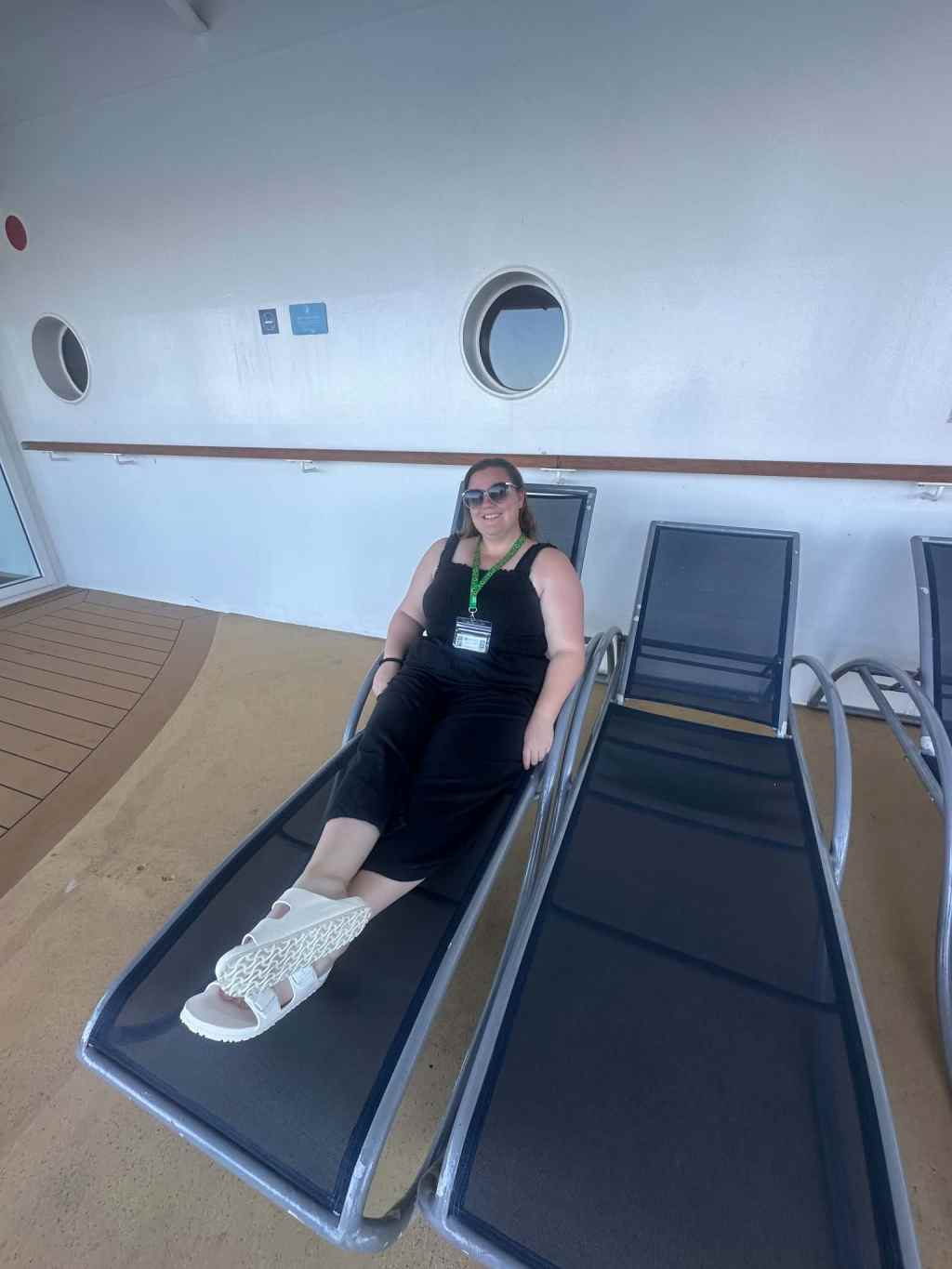
I don’t usually cruise. My family tends to travel in a very different way. We’re much more get up early, get on the bus, see as much as possible, move to another hotel and do it all again tomorrow people.
So when we were planning our trip around Europe and looking at the different ways we could visit the Greek Islands, a cruise wasn’t necessarily our first choice.
But when we compared the options, cruising made sense. It was more affordable, it meant we could visit several islands without constantly packing and unpacking, and it allowed us to see a lot of places without having to organise all of the transport between them ourselves.
And actually, there were some things about cruising that I really loved as an autistic traveller. There were also some things that I found incredibly difficult. Both can be true.
The ship was loud. Really loud.
The first thing I noticed when we boarded was the noise. The ship was huge, with thousands of people on board, and there seemed to be very little escape from the sound.
In the centre of the ship was a bar and entertainment area with live music. The music was loud enough that it wasn’t just something you noticed when you were sitting in the bar.
You could hear it throughout the ship. Even when you stepped out of your room. Even when you were on a different level. For someone who is sensitive to sound, this made parts of the ship quite difficult.
The entertainment areas were essentially off limits for me. The combination of loud music, crowds, bright lights and lots of activity was simply too much.
The ship was particularly busy at night, when most people had returned from their excursions and were enjoying the entertainment.
The crowds themselves weren’t always a problem for me. The buffet was a different story, and we generally avoided it in favour of eating in our allocated dining room, which gave me a much more predictable experience.
Having a set dining time was actually helpful. I knew where I was going. I knew roughly what to expect. We had the same waiter every single day. And I didn’t have to navigate the chaos of thousands of people trying to eat at once.
The sunflower lanyard wasn’t recognised
I wore my sunflower lanyard every single day. Nobody from the cruise line acknowledged it. I eventually spoke to Guest Services about it because I had expected that the lanyard would communicate that I had an invisible disability.
Unfortunately, the person I spoke to didn’t seem to understand what it was. I found the interaction uncomfortable, particularly because I felt as though the situation was almost being laughed off. That was difficult.
Not because I expected everyone to treat me differently, but because a sunflower lanyard is supposed to be a way of discreetly communicating that someone may need additional understanding or support.
I had also discovered after booking that Royal Caribbean was associated with Autism on the Seas, which initially made me really excited.
I thought that perhaps there was more understanding and support available than I had realised. However, my experience on this particular cruise didn’t reflect that.
I had contacted Royal Caribbean before travelling, although unfortunately I didn’t receive a response before my cruise.
Nothing major went wrong for me personally. I had requested an accommodation around being able to wear shorts in the dining room, and this wasn’t a problem. But it did make me think about other autistic travellers who might have greater support needs than I do.
If someone is told that accommodations are subject to availability, I completely understand that some requests may not be possible. But I also think there are some accommodations that should be treated as reasonable and straightforward.
For me, being able to wear clothing that helps me regulate my temperature and sensory comfort should never have been something that created a barrier to accessing a dining room.
The excursions were actually manageable
One thing that surprised me was that I didn’t find the excursions themselves particularly difficult. They were relatively short and manageable. The difficult part was often everything that happened around them.
Thousands of people had to gather in the theatre before we could disembark. We would be grouped together and given instructions before everyone moved off the ship. When you have thousands of people doing the same thing, it can become chaotic.
I found the instructions weren’t always as clear as I would have liked, and I’m not particularly comfortable when people start pushing in front of me or moving unpredictably.
That happened quite a lot. So for me, the challenge wasn’t necessarily: Can I cope with this excursion?
It was: Can I cope with getting thousands of people from the ship to the excursion?
That’s an important distinction.
But then I could go back to my room
This is where cruising surprised me. For all of the things I found difficult about the ship, there was one huge advantage. I had my own room.
At any point, I could go back there. I could close the door. I could be alone. I could decompress. After a busy day exploring somewhere new, I didn’t have to get on another bus, navigate another train station or find another hotel.
I could simply return to my room. And everything I needed was already there. I didn’t have to pack my suitcase every morning. I didn’t have to carry my belongings around. I didn’t have to worry about moving from one hotel to another. The ship travelled while we slept. For me, that was a huge benefit.
This was a much slower pace than I’m used to
Normally, my family travels at a very fast pace. Our bus tours involve early mornings, long days, long stretches on buses, new hotels and packing and unpacking constantly. The cruise was completely different. We would go out for an excursion, come back to the ship, and then I could have as much alone time as I needed.
That built decompression time into my day without me having to deliberately create it. I didn’t have to think: When am I going to get some time alone? I knew it was there. And I think that is one of the reasons I recovered better after busy days than I sometimes do on other holidays.
The cruise gave me a level of predictability and physical stability that I hadn’t really considered beforehand. The ship was my accommodation. It was my transport. It was my restaurant. And it was the place I could retreat to. Everything was in one place.
Athens gave me a completely different experience
One of the highlights of the entire cruise happened before we even really got started. At security in Athens, one of the staff members noticed my sunflower lanyard.
She asked if she could borrow it for a moment. She then gathered her colleagues around and explained what it meant. That moment meant a lot to me.
After days of wearing my lanyard without anyone acknowledging it, someone had recognised it immediately and understood why I was wearing it. It was such a small interaction. But it made me feel seen.
Interestingly, the person who recognised my lanyard in Athens wasn’t associated with the cruise line. It was port security. That experience really highlighted how different accessibility can feel depending on who you encounter.
Would I cruise again?
Yes. Absolutely. But next time, I might choose a smaller ship.
I think a smaller ship would potentially give me some of the benefits I loved about cruising while reducing some of the sensory challenges that came with being on such a huge vessel with thousands of people.
And that’s probably the biggest thing I took away from the experience. Cruising isn’t simply good or bad for me as an autistic traveller. There were parts that were incredibly difficult. The noise was intense. The entertainment areas weren’t accessible to me from a sensory perspective. The crowds and unclear instructions around disembarking were challenging. And I was disappointed that my sunflower lanyard wasn’t recognised by the cruise line.
But there were also things I loved. I could retreat to my own room. I had somewhere private to decompress. I didn’t have to pack every day. I could travel between destinations overnight. And after a busy day, I could simply close my door and be alone. That matters.
What I wish travel companies understood
I don’t think neurodivergent accessibility has to mean completely redesigning a holiday. Sometimes it can be as simple as understanding what a sunflower lanyard means. Sometimes it means providing clear instructions. Sometimes it means allowing someone to wear comfortable clothing. Sometimes it means having a quieter space. And sometimes it simply means recognising that someone may need to step away from the crowd.
Cruising gave me a really interesting lesson in accessibility. Something can be sensory overwhelming and incredibly useful at the same time.
I wouldn’t say that my cruise was particularly neurodivergent friendly. But I also wouldn’t say that I wouldn’t cruise again. Because for me, the ability to explore somewhere new and then return to a private space at the end of the day was incredibly valuable. And perhaps that’s what accessible travel needs to become. Not asking whether something is simply accessible or inaccessible. But asking: Accessible in what ways, and for whom? Because the things that make a holiday difficult for one person might be the things that make it possible for someone else.



Leave a comment