Have you ever met someone and suddenly found yourself thinking about them all the time?
You notice every little change in their tone. You replay conversations in your head. You look forward to seeing them again. You notice when they take longer to reply. You might find yourself wondering whether they still care about you, whether something has changed, or when you’re going to see them next.
And sometimes you might even think: Why do I care about this person so much?
I’ve spent a lot of my life asking myself that question.
For a long time, I didn’t really have a word for what was happening. I sometimes called it an obsession because that was the only way I knew how to describe the intensity of it. Other people sometimes used that word too.
But the more I’ve learned about myself as a late diagnosed AuDHDer, the more I’ve started to understand that there may be more going on than simply being obsessed with someone.
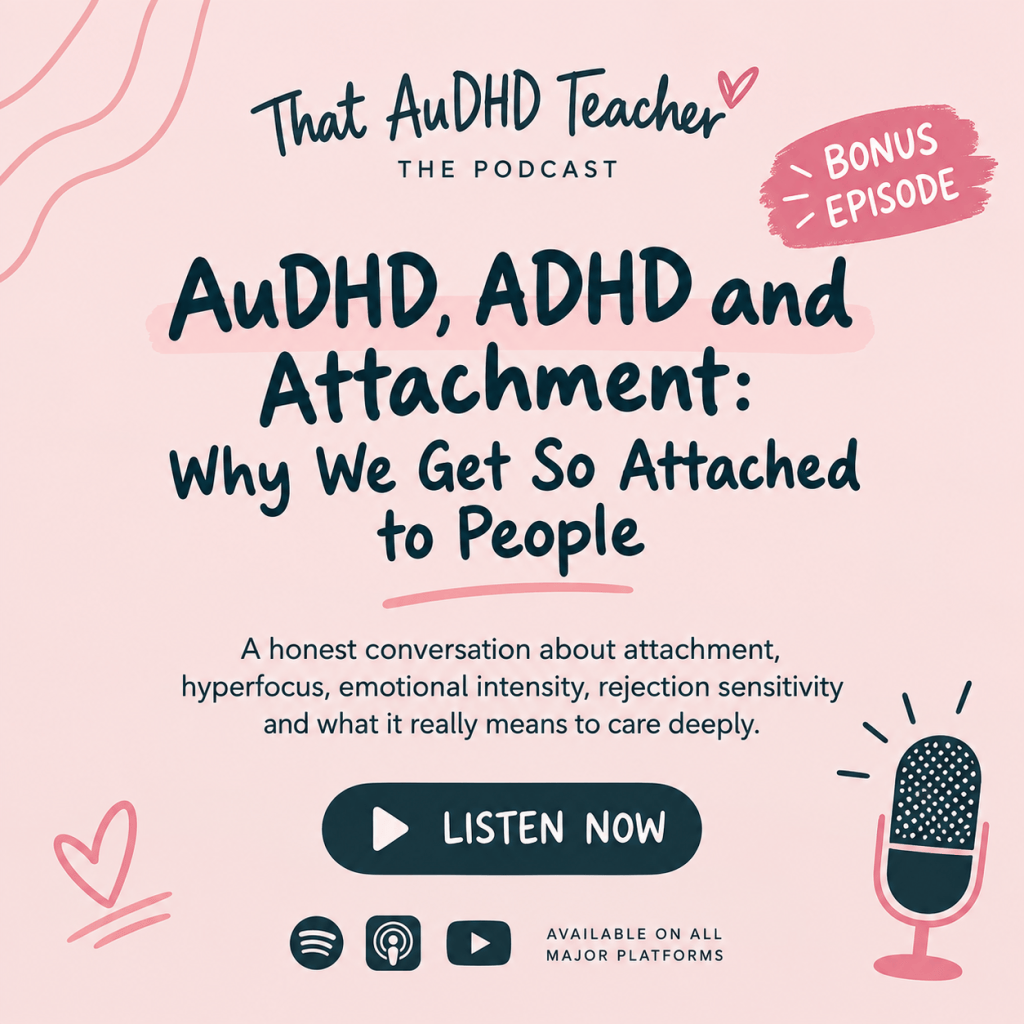
In Bonus Episode 13 of That AuDHD Teacher, I sat down with my best friend Emma to talk about something we’ve both experienced for most of our lives: deep attachment to particular people.
What does it mean to become deeply attached to someone?
When I say attachment in this post, I’m not talking specifically about attachment styles such as secure, anxious or avoidant attachment.
I’m talking about something much more personal. It’s that experience of when a particular person becomes incredibly important to you.
You think about them when they’re not there. You want to spend time with them. You remember tiny details about them. Their attention means a lot to you. You might notice small changes in their behaviour that you wouldn’t necessarily notice in other people. And when something changes in the relationship, even something relatively small, you can feel it enormously.
Emma and I realised during our conversation that we’ve both been like this for a very long time.
This isn’t something that suddenly appeared in adulthood.
We’ve been attaching deeply since childhood
One of the things I found particularly interesting about our conversation was realising just how far back this goes.
As children, we both had particular people who became especially important to us.
For me, these were often adults, particularly teachers and dance teachers. I was a very quiet child and was often perceived as being well behaved because I didn’t cause problems or demand attention.
But when someone actually noticed me, understood me or took the time to get to know me, that meant a lot.
I think there was something about feeling understood that created a sense of safety.
Emma described something similar. Certain teachers stood out because they acknowledged her and made her feel noticed.
Looking back, it makes sense that people who made us feel safe and understood could become particularly important.
At the time, though, we didn’t have the language to explain any of this.
We just knew that certain people mattered a lot.
When a person becomes a hyperfocus
One of the biggest realisations from our conversation was that a person can become a kind of hyperfocus.
For someone with ADHD or AuDHD, hyperfocus is often discussed in relation to activities, interests or hobbies.
But what happens when the focus becomes a person?
You might find yourself:
- Thinking about them constantly
- Replaying conversations
- Remembering tiny details about them
- Looking forward to seeing them
- Noticing small changes in their behaviour
- Talking about them frequently
- Looking for opportunities to see them again
- Wanting reassurance that they still care
- Struggling to concentrate on other things when something feels uncertain
Emma jokingly described her special interest as people. And honestly, that made a lot of sense.
Sometimes the person isn’t doing anything particularly unusual. They’re simply someone who has become very important to you, and suddenly your brain seems to want to analyse everything about the relationship.
The role of uncertainty
One of the biggest themes we kept coming back to was uncertainty.
When someone matters deeply to you, uncertainty about that relationship can feel enormous. Someone takes longer than usual to reply. Their tone seems slightly different. Plans change. You don’t know when you’ll see them next. You ask yourself whether something has changed.
And suddenly your brain starts asking questions.
- Are they upset with me?
- Did I do something wrong?
- Do they still care?
- When will I see them again?
- Has something changed?
For Emma, one way of dealing with this uncertainty can be creating a future opportunity to see someone again. Having a plan can provide some sense of certainty.
For me, uncertainty can be particularly difficult because I don’t like not knowing what is going to happen.
This is one area where my autism and ADHD can intersect with attachment in ways that I am still trying to understand.
Rejection sensitivity and reassurance
We also talked about rejection sensitivity. When someone is particularly important to you, the possibility of rejection can feel incredibly significant.
Even something as simple as waiting for a reply can create a physical feeling of anxiety. And sometimes what you’re actually looking for isn’t constant attention.
It’s reassurance. You want to know that everything is okay. You want to know that the relationship hasn’t changed. You want to know that the person still cares.
The difficult part is that asking for reassurance can itself feel incredibly vulnerable. So sometimes you might find yourself looking for evidence instead.
You’re analysing someone’s behaviour. You’re replaying what they said. You’re noticing whether they seem different. You’re looking for signs that everything is still okay.
When attachment becomes all consuming
There is also a point where deep attachment can become exhausting. For me, the distinction isn’t always obvious. I don’t necessarily notice a specific moment where caring about someone turns into thinking about them constantly. But I know that it has crossed a line when it starts affecting other parts of my life.
During our conversation, Emma described noticing things such as disrupted sleep, reduced appetite and repetitive thoughts when an attachment becomes particularly intense.
For me, rumination can become a huge part of it. If something feels unresolved, my brain can become desperate to fix it.
We talked about the idea of rupture and repair during the episode. Sometimes nothing dramatic has even happened. Something simply hasn’t gone according to what you expected. But until the situation feels repaired, your brain can struggle to let it go.
Why might AuDHD play a role?
I don’t think there is one single explanation for why some people experience attachment more intensely than others.
For me, being AuDHD is one part of the picture.
ADHD can involve things such as emotional intensity, hyperfocus and rejection sensitivity. Autism can also influence how we experience relationships, uncertainty, social interaction and connection.
But our conversation also made me realise that childhood experiences, personality and individual temperament may all play a role.
And everyone’s experience is going to be different. Being neurodivergent doesn’t automatically mean that you will become intensely attached to particular people. Equally, experiencing deep attachment doesn’t automatically mean that you are neurodivergent.
There isn’t one simple explanation.
Is being deeply attached a bad thing?
This is probably the most important part of the conversation for me. No. Being deeply attached isn’t automatically a problem.
Humans are supposed to form attachments. Relationships matter. Connection matters. Feeling safe with another person matters. And honestly, one of the things I value most about myself is that I care deeply.
The difficulty isn’t necessarily the depth of the feeling. It’s when the intensity becomes so overwhelming that it starts making life harder.
There’s a difference between: This person is really important to me and I can’t think about anything else because I don’t know whether this person still cares about me
Learning to recognise that difference is something I’m still working on.
You’re not too much
If you’ve listened to this episode and found yourself thinking, Oh my gosh. That’s me, I hope you know you’re not alone.
Maybe you’ve spent years wondering why you become so attached to particular people. Maybe you’ve called yourself obsessive. Maybe you’ve wondered why other people don’t seem to experience relationships in quite the same way. Maybe you’ve felt embarrassed about how much you care. Or maybe you’ve spent years trying to convince yourself that you need to care less.
I’m not sure that the answer is necessarily to care less. I’m learning that understanding why I experience things so intensely is much more helpful than judging myself for experiencing them.
There are still parts of this that I don’t understand. I’m still learning what attachment looks like for me. I’m still learning how autism, ADHD, childhood experiences, relationships and my own personality all interact. But I don’t think being someone who feels deeply is something I need to be ashamed of.
Sometimes it makes things harder. But it also means I can form incredibly meaningful connections with people. And I think that’s something worth holding onto.
Listen to Bonus Episode 13
In Bonus Episode 13 of That AuDHD Teacher, I talk about all of this with my best friend Emma, who has experienced many of the same patterns throughout her life.
We talk about childhood attachments, teachers, relationships, hyperfocus, reassurance, rejection sensitivity, uncertainty, dopamine, people pleasing, masking and what happens when a person becomes the focus of your thoughts.
It’s a very personal conversation, and honestly, we probably could have talked for another couple of hours.
If you’ve ever wondered Why do I get so attached to people?, this conversation is for you.
And if you’ve ever felt like you’re “too much” because you care deeply about the people in your life, I hope this episode reminds you that you’re not alone.
Sometimes we don’t need to learn how to care less. Sometimes we need to learn how to understand ourselves better.
Please remember that this post is based on our personal experiences and isn’t intended as clinical or medical advice. Experiences of attachment and neurodivergence vary from person to person.




Leave a comment