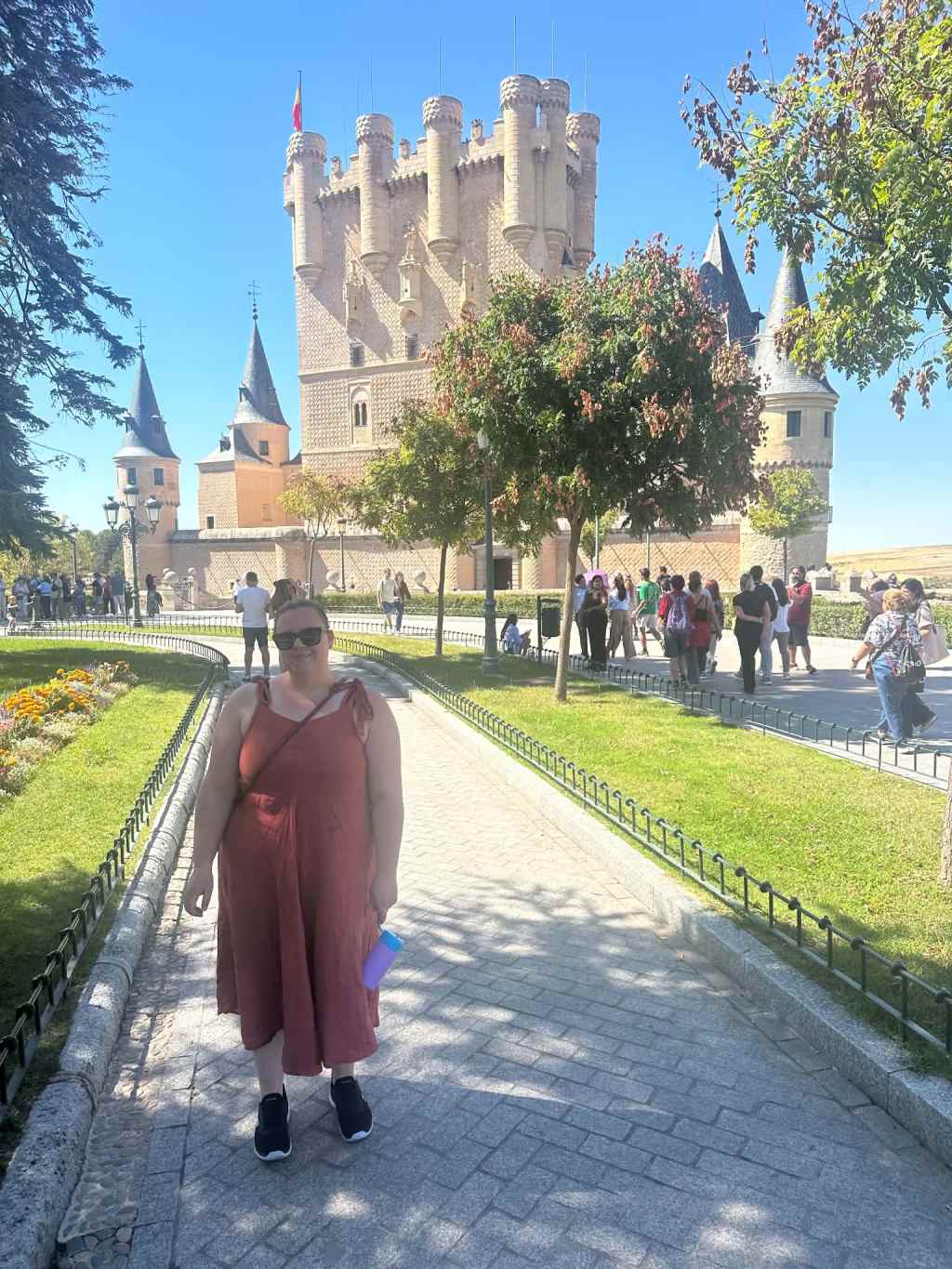
I’ve always loved travelling. I’ve also always found group situations complicated. So the idea of spending nine days travelling around Spain with 48 other people might not immediately sound like the most obvious holiday for an autistic person.
But this was my second Costsaver tour. And it taught me something I wasn’t expecting. Sometimes the right structure, the right people and the right support can make group travel work surprisingly well for me.
Why Spain?
My parents have travelled on six bus tours around Europe. Spain was one of the places they hadn’t visited yet. I hadn’t been either, so when we were looking at options for our holiday, Spain seemed like an obvious choice.
We chose Costsaver because it is generally a little more affordable than some of the other organised tour options. We don’t mind staying a little further from the main city centres or having to carry our own bags, so it works well for us.
We’ve had fantastic experiences with Costsaver, and we also really like Trafalgar as a travel company. But I wasn’t sure how I would find the experience as an autistic traveller.
I actually like the structure of bus tours
This might sound strange considering I just said I struggle with group travel.
But there are parts of bus tours that work really well for my brain.
I like having somewhere to be. I like knowing when I need to wake up. I like knowing when we’re leaving. I like having the same bus. The same driver. The same people. And someone else handling the logistics.
I’m not someone who particularly enjoys having to navigate unfamiliar transport systems or work out how to get from one place to another. On a bus tour, the bus takes you where you need to go.
Someone else has worked out the route. Someone else knows the schedule. Someone else tells you what is happening. That removes a huge amount of cognitive load. And because I have ADHD as well as autism, I actually enjoy the fast pace.
The days are busy.
We’re up early. We’re moving. We’re seeing things. We’re doing things. We’re not spending hours wondering what we’re going to do that day.
So although my autism likes the consistency of the routine, my ADHD also likes the constant movement. It’s an interesting combination.
But socially, group travel is hard
This is where things get complicated. I’m not naturally someone who fits easily into a group. I watch people making friends and wonder how they seem to do it so effortlessly. I struggle to join group photos. I often end up sitting somewhere wondering how everyone else has suddenly become friends. And I need a lot of alone time.
Being around other people all day can be exhausting. So I pay extra for a single person room and my own seat on the bus.
For some people, that might seem like an unnecessary expense. For me, it is absolutely worth it.
At the end of the day, I need somewhere that is mine. Somewhere I don’t have to talk. Somewhere I don’t have to mask. Somewhere I can decompress. Having my own hotel room gives me that.
I told my tour director that I was autistic
Before the tour, I told my tour director that I was autistic. I didn’t ask for anything complicated. All I asked for was clear instructions. She gave me much more than that.
Every day, she checked in with me. During busy activities, she would quietly make sure I was okay. She made sure I had my noise cancelling headphones with me. If something changed, she explained what was happening. And she always checked in privately.
She never made me feel like I was a problem. She never made me feel like I was being difficult. She never treated me differently in a way that made me feel singled out. She simply understood. And that made an enormous difference.
There was one night I became really overwhelmed
One evening, we were at an optional experience and I became overwhelmed. I left crying. My tour director noticed immediately.
She came over, helped me sit down, got me some water and stayed with me until I had started to come down.
She didn’t make it dramatic. She didn’t ask me why I couldn’t just cope. She didn’t tell me I was overreacting. She understood what was happening. And that is what I think is missing from a lot of conversations about autism. You don’t necessarily need someone to know everything about autism.
Sometimes you just need someone who understands that when an autistic person becomes overwhelmed, there is usually a reason. And that the solution isn’t to make them feel worse about it.
She wasn’t only looking after me
Something else really stood out to me. My tour director wasn’t attentive to me instead of everyone else. She was attentive to everyone. There were 48 people on our tour, and she seemed to be busy every second of every day. She remembered things about people. She checked on people. She helped people. She organised everything. She was constantly working. And somehow, she still noticed when I needed a little extra support.
I honestly looked at her in awe. I don’t know how she did it.
I could withdraw when I needed to
There were times when I needed to step away. And I was able to. I didn’t participate in absolutely everything.
There were a few times when I had to choose rest over sightseeing because I knew my energy was running low.
One of those decisions meant missing Valencia. That was hard. I didn’t want to miss it. But I also knew myself well enough to understand that if I pushed through, I might not have been able to participate in some of the things that came afterwards.
Sometimes being an autistic traveller means making difficult choices.
You have to ask yourself: Do I want to do this?
and Can I actually do this without compromising the rest of my trip?
Those aren’t always the same question.
The bus itself worked surprisingly well
I don’t mind long stretches on a bus. I know that might sound strange to some people, but sitting on a bus for hours doesn’t really bother me.
Sometimes the sensory environment was difficult, so I used my noise cancelling headphones and sensory toys. I also used Loop earplugs when we were in busy environments. But having the same bus and the same driver every day gave me familiarity.
I didn’t have to work out a new transport system every morning. I didn’t have to figure out where I was going. I could sit down and let someone else handle the journey. For me, that’s a form of accessibility too.
There were crowds
Crowds are difficult for me. Spain has plenty of them.
There were busy tourist attractions, busy streets and places where there were lots of people around. But our tour director was particularly good at looking after the group in crowded areas.
She was conscious of things like pickpockets and made sure everyone knew what was happening. That helped me feel safer.
And when the sensory environment became too much, I had my headphones or earplugs. Again, it wasn’t about eliminating every difficult environment. It was about having strategies to manage them.
Something unexpected happened
I actually made friends. Well, sort of. I exchanged contact details with a few people from the tour. That might sound completely ordinary. For me, it was a milestone. Social situations have never been particularly easy for me.
I often watch other people make connections and wonder why it seems so natural for them.
So leaving a nine day tour with contact details for people I genuinely wanted to keep in touch with felt significant. And I think part of that came from being around the same people every day.
When you’re autistic, meeting a different group of strangers every day can be exhausting. With a tour, you gradually get used to the same people. You learn their personalities. They learn yours. The uncertainty decreases. And that familiarity can make socialising much easier.
I was actually sad when the tour ended
This surprised me. At the beginning, I wasn’t sure how I would cope with being around 48 people for nine days. By the end, I was sad it was over.
I had started getting comfortable. I had started recognising people. I had made some connections. And I would have happily spent more time with some of them.
I think that’s an important reminder that autistic people aren’t necessarily antisocial. Sometimes we simply need more time. More familiarity. More predictability.
And the opportunity to connect without having to immediately navigate a completely unfamiliar social environment.
What made this tour work for me?
I don’t think it was one single thing. It was the combination of everything. The structure worked for my autism. The fast pace worked for my ADHD. The same bus and driver provided familiarity.
Having my own room gave me somewhere to decompress. Noise cancelling headphones and sensory tools helped with the difficult environments. And, perhaps most importantly, I had a tour director who understood autism.
I didn’t need her to change the entire tour for me. I just needed her to understand why certain things were difficult. And she did.
This is what I wish more people understood about autism
Sometimes autistic people are described as difficult. Dramatic. Inflexible. Overly sensitive. Unfriendly.
But my experience on this tour reminded me that sometimes what makes the difference is simply understanding.
When I became overwhelmed, my tour director didn’t treat me as dramatic. She understood.
When I needed to step away, she didn’t make me feel guilty. She understood.
When I needed clear instructions, she gave them. She understood. And that small amount of knowledge changed my entire experience.
Would I do another bus tour?
Absolutely. In fact, my experience reinforced why my family enjoys them so much. They’re busy. They’re organised. They’re efficient.
You get to see a huge amount in a relatively short period of time. And someone else handles the logistics. For an autistic traveller, that doesn’t necessarily make a bus tour easy.
But for me, the structure actually provides something valuable. I know when I’m waking up. I know when we’re leaving. I know where we’re going. I know I’ll have my own room at the end of the day.
And I know that if something unexpected happens, there is someone else who knows how to handle it. That last part matters more than I realised.
Because travelling independently means that when something goes wrong, I have to navigate it. On an organised tour, I don’t necessarily have to. And that can remove a huge amount of stress.
The biggest lesson I took from Spain
I went into this trip wondering whether group travel was really compatible with being autistic. I came away thinking that perhaps the question is different.
Maybe it’s not: Can autistic people do group tours?
Maybe it’s: What makes a group tour accessible for an autistic person?
For me, it wasn’t removing the group. It was having structure. Having consistency. Having somewhere private to retreat. Having sensory tools. Having the freedom to step away when I needed to. And having someone who understood that autism isn’t always obvious from the outside.
Sometimes the most important accommodation isn’t a special service. It’s a person who knows enough to understand what they’re seeing. And I was incredibly lucky to have that person on my tour.
I told my tour director at the end of the trip how much her support had meant to me. I wrote her a card and gave her a small gift. Because she probably didn’t realise just how much of a difference she had made.
But I did. And I won’t forget it.


Leave a comment