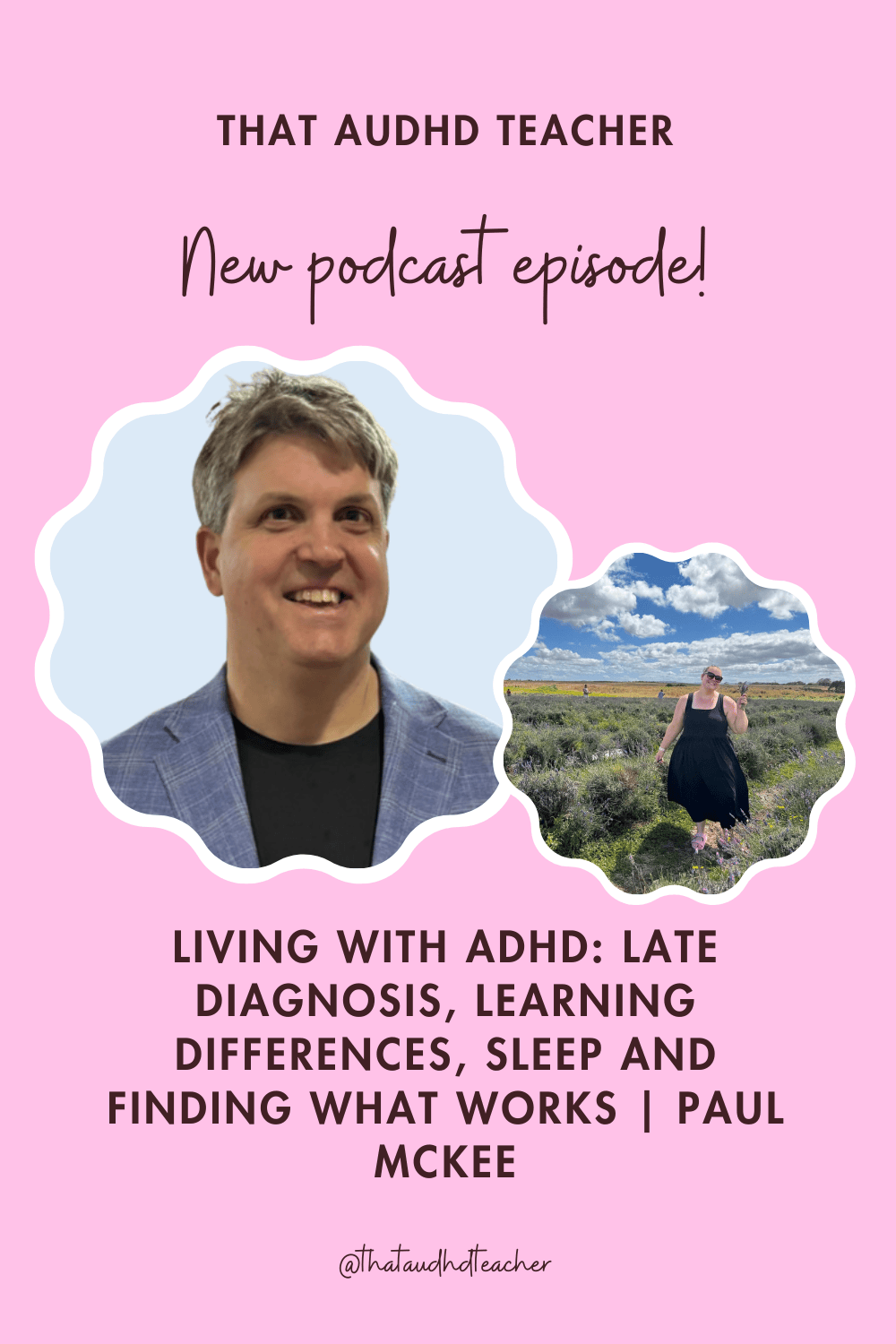
What happens when you spend years believing you’re not good at learning, only to discover that the problem wasn’t your intelligence at all?
In my latest episode of That AuDHD Teacher, I sat down with Paul McKee to talk about his experience of growing up misunderstood at school, receiving an ADHD diagnosis in adulthood, and gradually learning how to work with his brain rather than constantly fighting against it.
Paul’s story is a reminder that the way someone performs in a particular environment doesn’t necessarily reflect what they’re capable of. It’s also a conversation about the importance of understanding ourselves, finding strategies that fit our individual needs, and recognising that there isn’t one right way to learn or work.
As someone who was diagnosed with AuDHD as an adult myself, I found this conversation particularly interesting. Our experiences aren’t identical, but I think there’s something important in hearing how different neurodivergent people have navigated their lives before and after understanding their brains.
Being labelled as the “dummy” at school
One of the most striking parts of Paul’s story is how he was perceived during childhood.
He describes being placed in remedial classes and repeatedly being treated as someone who struggled academically. Over time, those messages became part of how he understood himself.
But his father didn’t recognise the same picture. He believed Paul was bright and questioned why the school was describing his son so differently.
That disagreement eventually led Paul’s mother to seek an independent learning assessment. It was a significant commitment for his family, but it helped them begin to understand what was happening.
Paul recalls the learning specialist describing his brain as a Ferrari without tyres. He had the ability to learn quickly, but he struggled to sustain that learning in the way the school expected.
Through working with the specialist, Paul discovered that he could absorb a huge amount of information in short bursts, but that his concentration dropped off after roughly 30 minutes.
This made a considerable difference to how his education was approached.
Rather than continuing to expect him to learn in the same way as everyone else, his high school accommodated him with shorter classes and breaks between them. He describes how much better this approach worked for him.
The difference was so noticeable that when he later encountered people from his previous school, they struggled to understand how the student they remembered had changed so much academically.
But, as Paul explains, he hadn’t suddenly become more intelligent. He had found an environment that worked better for the way he learned.
It’s a powerful reminder that struggling within a particular system isn’t the same as lacking ability.
Discovering ADHD as an adult
Although Paul had found ways to manage his learning throughout school and university, adulthood brought a different set of challenges.
He had developed ways of working around his concentration patterns, but those strategies became much harder to maintain once he had children and less control over his time.
He describes reaching a point where the mental load became overwhelming. He was struggling to manage his thoughts and focus, and eventually slept for two days. His wife noticed how unwell he seemed and encouraged him to see a doctor.
During that appointment, his doctor asked whether he had ever been assessed for ADHD.
Paul was subsequently referred to a specialist and received his diagnosis in approximately 2016 or 2017, when he was in his mid-thirties.
Looking back, he could recognise patterns that had been present for much of his life. However, having an explanation didn’t mean everything immediately became easy.
Paul talks openly about trying different approaches after his diagnosis, including medication that he found difficult to tolerate. He eventually developed his own ways of managing his daily life.
His experiences with treatment are personal to him, rather than a recommendation for what other people should try. What works for one person may not work for another, and ADHD treatment decisions are best made with an appropriately qualified health professional.
What stood out to me was how long Paul had spent trying to make things work without fully understanding why certain approaches were so difficult for him.
Receiving a diagnosis gave him another way to understand his experiences.
Finding ways to work with your brain
One of the biggest themes in our conversation was the importance of figuring out what works for you as an individual.
Paul explains that he can be exceptionally productive during short periods of focused work. When a task fits his attention patterns, he can move through it quickly and absorb a lot of information.
But he also recognises that his concentration has limits. Once he reaches that point, pushing himself to continue doesn’t necessarily produce better results.
Over time, he has learned to organise his work around these patterns, particularly because much of his career has involved project-based work.
This doesn’t mean that every person with ADHD will have the same concentration pattern or that working in short bursts is the answer for everyone. Paul’s experience is specific to him.
However, it raises an interesting question: how much time do we spend trying to force ourselves into systems that don’t suit us, rather than looking at what we might need to change?
Paul makes the point that people often want a checklist of things they should do to improve their lives. While general advice can be useful, he believes we also need to spend time getting to know ourselves and noticing what genuinely helps.
I think that’s an important distinction.
It’s easy to see advice online about productivity, sleep, routines or managing ADHD and feel as though we’re doing something wrong if it doesn’t work for us. But our needs, environments and circumstances aren’t identical.
Sometimes the most useful starting point isn’t finding another list of things we should be doing. It’s paying attention to our own patterns and working out what helps us function better.
ADHD, sleep and understanding your own needs
We also talked about sleep, which became an important part of Paul’s journey.
He explained that he had spent a long period sleeping for only a few hours a night. He hadn’t fully appreciated how unusual his sleep patterns were until his wife noticed them.
Eventually, he sought specialist help and underwent a sleep study. Through this process, he learned more about his sleep difficulties and the conditions that seemed to help him rest.
Paul found that factors such as temperature, darkness and noise made a significant difference to his ability to sleep. He also described how keeping track of his sleep helped him understand his own patterns.
Over time, he was able to improve the amount of sleep he was getting.
What I found interesting was the way this connected to the wider theme of the conversation: understanding your own needs rather than assuming everyone can function under the same conditions.
For some people, background noise might help them concentrate. For others, it might make focusing almost impossible. Some people work well with rigid routines, while others need more flexibility.
Sleep is also a good example of why generic advice doesn’t always tell the whole story. It can be helpful to develop routines and notice patterns, but persistent sleep difficulties deserve appropriate medical support rather than being treated as simply a matter of willpower.
Paul’s experience isn’t a universal ADHD sleep pattern, but it illustrates how learning more about yourself can help you identify questions to explore and changes that might be worth discussing with a professional.
Recognising similarities between yourself and your children
Another part of our conversation explored Paul’s experience of parenting a daughter who was also diagnosed with ADHD.
Paul recognised similarities between the two of them, particularly in how they approach tasks, become absorbed in things and manage their attention.
Having his own experiences to draw on means he can sometimes offer his daughter suggestions based on what has helped him.
But he also acknowledges that they aren’t exactly the same.
Even when two people share similar traits, their needs can differ. Something that works well for one person might not work for another.
He describes learning to recognise how stress affects his daughter’s ADHD differently from his own experience, and how important it is to understand what she needs rather than simply assuming she will respond as he does.
I think this is such an important point for parents.
Recognising similarities can help us empathise with our children and understand some of the challenges they might face. But it doesn’t mean we have all the answers.
Our children are individuals. They deserve the opportunity to discover their own strengths, needs and ways of doing things, with support that reflects who they are.
ADHD, entrepreneurship and seeing possibilities differently
Paul’s story doesn’t stop with school and diagnosis. His career has taken him through engineering, teaching and online education.
He describes how he enjoyed the problem-solving side of engineering, but eventually realised that the work itself wasn’t what he wanted to do long term.
An unexpected opportunity to build websites led him into a new direction. He began creating online resources, eventually developing educational websites and working in the online education industry.
Throughout our conversation, Paul reflected on how his ADHD-related tendencies have influenced his approach to work and entrepreneurship.
He enjoys coming up with ideas, solving problems and working on projects. He also talks about being comfortable with certain kinds of risk and being willing to try something new, even when he doesn’t have every detail figured out in advance.
Of course, ADHD doesn’t automatically make someone entrepreneurial, and running a business comes with its own challenges. Paul’s experience is one example of how particular traits can feel difficult in one context and useful in another.
What matters is that he has gradually found work that makes better use of the ways he likes to think and operate.
That idea really resonated with me. There is a difference between expecting ourselves to fit a particular mould and exploring whether there are other ways to approach work and life.
Sometimes a change in direction can open up possibilities we hadn’t considered before.
From creating paywalls to making educational resources free
One of the things I especially enjoyed learning about Paul was his current project, Free Worksheets.
Paul has spent many years in online education, including creating websites that offered educational resources through paid subscriptions. More recently, he began thinking about how expensive these resources can be for teachers, parents and homeschoolers.
As a teacher myself, I know how quickly the cost of educational materials can add up, particularly when educators are already spending their own money to support their work.
Paul decided to take a different approach.
Free Worksheets provides educational worksheets for teachers, parents and homeschoolers. The resources are created by teachers, and Paul explained that advertising revenue goes to the educators who create them.
He sees the project as a way to make resources more accessible and help break down the paywalls that have become common in online education.
You can explore the website here: Free Worksheets – freeworksheets.com
I loved hearing about this because it connects Paul’s professional experience with something he wants to contribute now. Rather than simply continuing to do what he has always done, he is using what he has learned to try to make educational resources more accessible.
What I took away from this conversation
There were several things I kept thinking about after talking to Paul.
The first was how easily other people’s assumptions can shape the way we see ourselves. If you spend years being told that you’re not good at something, it’s understandable that you might begin to believe it.
The second was how important it can be to find an environment that supports the way you learn and work. Paul’s experience changed significantly when his school adjusted the structure of his learning, rather than expecting him to keep doing something that wasn’t working.
And the third was that understanding yourself is an ongoing process.
A diagnosis can provide a new framework for making sense of past experiences, but it doesn’t automatically tell you exactly what to do next. Sometimes it takes time, experimentation and support to work out what suits you.
As an AuDHD adult, I’m still learning about my own brain and making adjustments to how I approach work and everyday life. Hearing other people’s experiences reminds me that there isn’t one universal way to navigate neurodivergence.
We can learn from one another without assuming that our experiences will be identical.
Paul’s story also highlights why it’s worth looking beyond labels and asking what someone actually needs to thrive. The student who was seen as struggling academically had abilities that became much more visible when the environment changed.
Imagine how many people might have a different experience if we were more willing to question our assumptions about ability, learning and success.
Listen to the full episode
In this episode of That AuDHD Teacher, Paul and I talk about his childhood experiences at school, receiving an ADHD diagnosis as an adult, learning differences, sleep, parenting, entrepreneurship and the process of discovering what works for you.
You can also explore Paul’s educational resources at Free Worksheets.
If you’ve ever felt as though you were trying to fit into a system that wasn’t designed for the way your brain works, I hope this conversation gives you something to think about.
Thanks for being here and for making space for these conversations about neurodivergence, lived experience and the different ways we learn, work and navigate life.
This article reflects Paul’s personal experiences as shared in our podcast conversation. It is not medical advice, and individual experiences of ADHD, sleep and treatment vary.


Leave a Reply