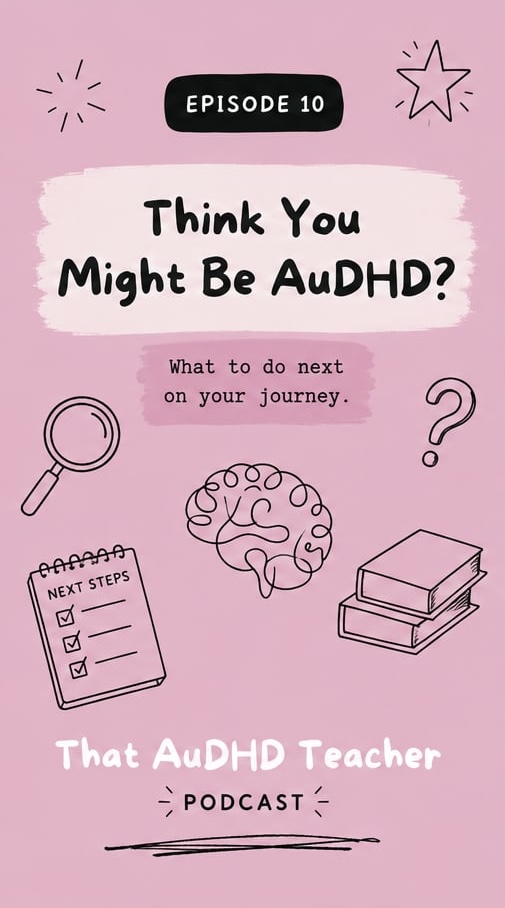
You’ve started recognising yourself. So… where do you go from here?
There is a particular moment that can happen when you start learning about autism and ADHD.
You hear someone describe an experience and think: Wait. I do that
Then you hear another one. “I do that too” And another.
And suddenly you’re looking back at years of your life wondering whether there might be an explanation for things you’ve always found difficult.
Maybe you’ve started wondering whether you could be autistic. Maybe ADHD sounds familiar. Maybe, like me, you start wondering whether both might explain more than either one on its own.
But then comes the next question: What do I actually do about it?
Start by being curious, not certain
If you’re recognising yourself in descriptions of autism or ADHD, it’s completely understandable to start wondering whether you’re neurodivergent.
But recognising yourself in a list of traits isn’t the same as having a diagnosis.
There are many reasons someone might experience difficulties with attention, sensory processing, social interaction, executive functioning, emotional regulation or routines.
So rather than immediately trying to prove or disprove a diagnosis, I think it can be useful to start by becoming curious about your own experiences.
What patterns have been there for a long time? What situations are particularly difficult? What takes you much more energy than it seems to take other people? What have you always thought was simply a personality trait?
Online screening tests can be a starting point
There are screening questionnaires available online for both autism and ADHD.
These can sometimes be useful as a starting point for reflection. They aren’t diagnostic tests. A result can’t tell you that you are or aren’t autistic or ADHD. But completing a screening questionnaire can sometimes give you language for experiences you’ve struggled to describe.
It can also give you things to explore further. If you complete one, I’d recommend saving your results rather than simply taking a screenshot and forgetting about it.
You may find them useful later when you’re talking with a professional.
Start writing things down
One of the most useful things I did was start noticing patterns.
Don’t just write: I struggle with social situations
Get specific.
What happens?
When does it happen?
What does it feel like?
What do you do to cope?
How much energy does it take?
What happens afterwards?
For example: After a busy social event, I often need several hours alone before I feel like myself again
is much more useful than: I’m bad at socialising
The details matter.
Think about childhood
Autism and ADHD are neurodevelopmental conditions, which means they’re not something that suddenly appears in adulthood.
That doesn’t mean you needed to have an obvious diagnosis as a child.
You may have masked. You may have been described as shy, sensitive, distracted, disorganised, emotional, dreamy, intense or “a perfectionist.” You might also have looked like you were coping.
So think back:
What were you like at school?
How did you handle friendships?
Transitions?
Homework?
Noise?
Routines?
Changes?
Organisation?
Were there things adults regularly commented on?
Sometimes the patterns become clearer when you look across your whole life rather than just at what’s happening now.
Gather evidence, not just traits
If you’re considering an assessment, think about examples and impact, rather than simply collecting a giant list of autism or ADHD traits.
What does this actually affect? Work. Study. Relationships. Daily life. Organisation. Emotional regulation. Sensory experiences. Communication. Sleep and routines.
The more clearly you can explain how something affects your life, the more useful that information can be during an assessment.
Find someone who understands adults
If you decide you want to pursue an assessment, finding an appropriately qualified clinician is important.
You don’t necessarily want someone who only understands the stereotypical presentation of autism or ADHD.
Adult assessment can be particularly nuanced, especially when someone has spent years masking or developing strategies to compensate.
It’s okay to ask questions before booking.
What experience do they have assessing adults?
Do they assess both autism and ADHD?
Are they familiar with masking?
What does their assessment process involve?
What information will they need from you?
You are allowed to find someone who feels like the right fit.
And remember: you don’t have to decide immediately
You don’t have to wake up one morning and decide: I definitely have autism
You can simply say: I’m noticing some patterns, and I want to understand them better
That’s enough. You can learn. You can read. You can listen to other people’s experiences. You can complete screening questionnaires. You can talk to a professional. You can decide not to pursue formal assessment right now.
There isn’t one correct way to approach this.
What helped me
For me, the process wasn’t about finding one piece of evidence that suddenly proved everything. It was about the pattern.
The more I learned, the more experiences from different parts of my life started connecting.
Things I’d previously considered completely unrelated started making sense alongside each other. And that process took time. I didn’t figure everything out overnight.
If you’re at the beginning of this journey
My biggest piece of advice would be: Slow down.
You don’t have to solve your entire identity in one week. Be curious. Write things down. Learn from reliable sources. Look at your whole life rather than just the last few months.
And if you decide to pursue assessment, go into it with examples of your actual experiences rather than trying to convince yourself that you have to perform autism or ADHD correctly.
You don’t have to become an expert in your own diagnosis before you’re allowed to ask questions.
Sometimes asking: Could there be an explanation for why I’ve always found this difficult?
is a good enough place to start.
🎧 Listen to Episode 10
This post accompanies Episode 10 of the That AuDHD Teacher podcast, where I talk about what you can actually do if you’re starting to wonder whether you might be autistic, ADHD or AuDHD.
I talk about screening questionnaires, reading and learning, gathering information about your childhood and preparing for an assessment.
And if you’re thinking about pursuing an assessment, the next two episodes go further into what the ADHD and autism assessment processes can look like.




Leave a comment