How do children learn to communicate? Is it simply a matter of waiting for their first words, or is there more we can do to support language development from the very beginning?
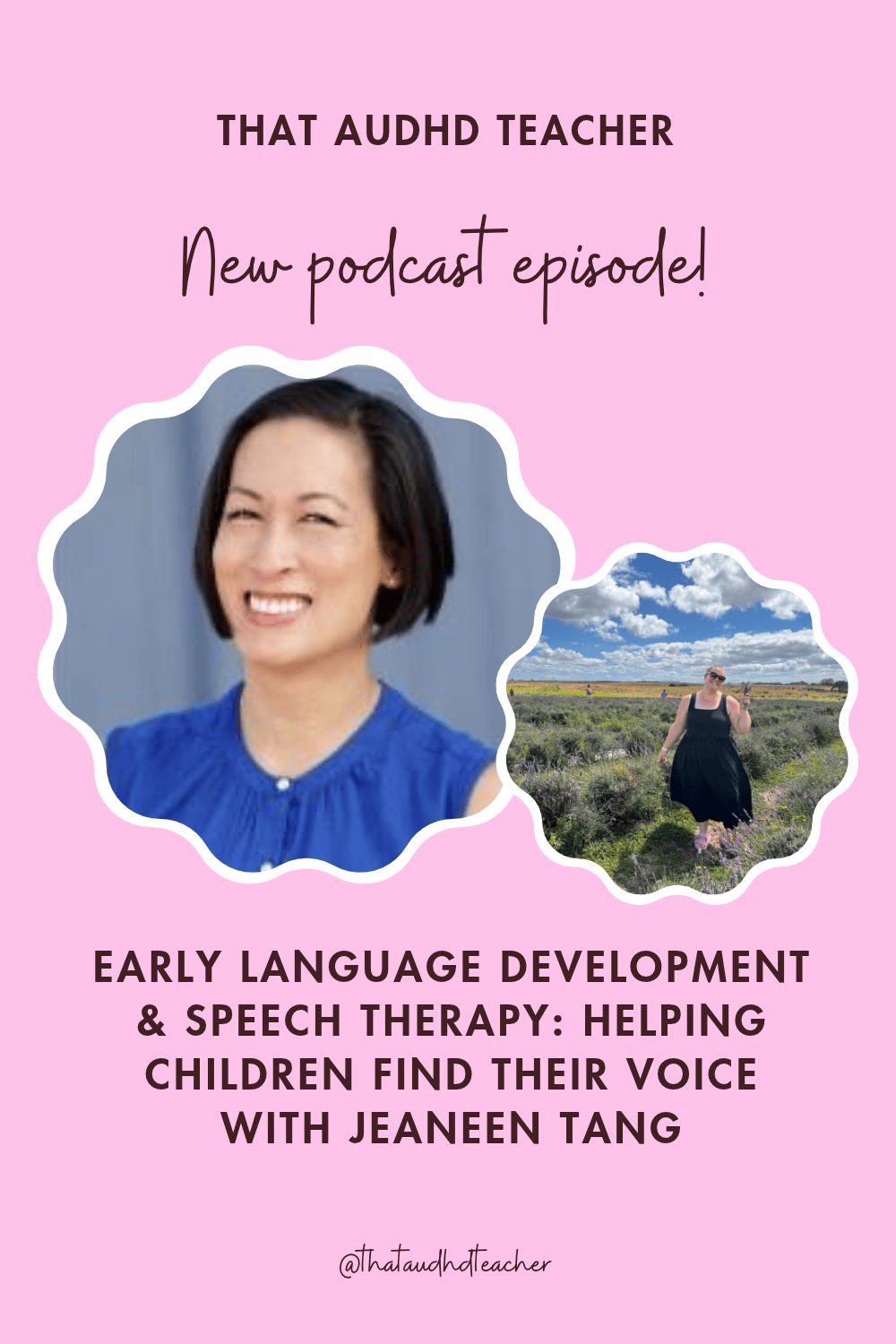
In a recent episode of That AuDHD Teacher, I spoke with Jeaneen Tang, a speech language pathologist with more than 20 years of experience, about early language development, communication, neurodivergence and the everyday interactions that help children develop their ability to express themselves.
One of the biggest takeaways from our conversation was that communication doesn’t simply happen in isolation. Children need opportunities to interact with the world around them, experiment with communication and practise expressing their needs, interests and ideas. And as parents and educators, sometimes that means learning to slow down and step back.
Language development doesn’t just happen
One misconception Jeaneen discussed is the idea that children will simply start talking when they’re ready, without necessarily needing much interaction or encouragement along the way.
Of course, children develop at different rates, and there is no single experience of language development. However, the experiences and interactions children have with the people around them play an important role.
Jeaneen shared examples of families who were meeting all of their children’s physical needs but hadn’t necessarily realised how important everyday interaction was for language development.
Talking, playing, singing, reading and introducing children to new experiences all provide opportunities to encounter language. Children cannot learn words and concepts they haven’t had opportunities to hear, see and experience.
This doesn’t mean parents and educators need to constantly talk at children. In fact, another important part of our conversation was recognising when to stop talking and give children space to respond.
Slow down and give children time to communicate
Something I particularly enjoyed discussing with Jeaneen was the balance between providing language and giving children opportunities to process and respond. As educators, we often hear about the importance of talking to babies and young children, narrating everyday routines and introducing vocabulary. But it is also possible to talk too much.
We can ask questions, provide explanations and narrate everything happening around a child without leaving much room for them to contribute. Jeaneen suggested thinking about interactions as conversations, even when a child isn’t using spoken words.
A few practical strategies include:
- Slow your speech down slightly so children have time to hear and process individual words.
- Pause after asking a question instead of immediately asking another one.
- Allow children time to respond in their own way.
- Pay attention to gestures, facial expressions, sounds and other forms of communication.
- Avoid jumping in too quickly to answer or complete an interaction for a child.
This is a useful reminder that communication is not simply about what adults say. It is also about whether we create space for children to participate.
What does “Play Dumb and Sabotage” mean?
Jeaneen is the author of Play Dumb and Sabotage: Mindfully Under-Anticipating the Child’s Needs and Creating Opportunities to Practice Language. The title is certainly memorable, but the idea behind it is particularly interesting.
Jeaneen explained that adults often anticipate children’s needs so quickly that children don’t always have an opportunity to indicate what they want or need.
For example, we might immediately hand a child their favourite toy, fill their cup or provide more food before they’ve had a chance to communicate that they want something. Her approach encourages adults to be more intentional about creating opportunities for children to practise communication. The “play dumb” part involves using humour, silliness and unexpected situations to encourage interaction.
Jeaneen shared an example of deliberately getting things wrong when talking with a child about a trip to the farm. Rather than asking the child to recount the experience directly, she made silly suggestions about the animals they might have seen. This encouraged the child to correct her and become involved in the conversation.
The “sabotage” part involves creating small, manageable opportunities for children to request, indicate or communicate something. For example, rather than putting an entire collection of toys in front of a child, an adult might keep a favourite toy visible in a container that needs help opening.
The intention is to create an opportunity for interaction, not to frustrate a child or withhold something they need. It’s about being thoughtful with the environment and allowing children opportunities to participate.
Offer choices instead of constantly asking yes or no questions
Another strategy from our conversation that I found particularly useful was Jeaneen’s advice about offering choices. Think about how often we ask children questions such as:
“Do you want to read a book?”
“Do you want to brush your teeth?”
“Are you ready to go?”
Sometimes, we’re asking these questions even though the activity isn’t actually optional. Jeaneen made a point that really stood out to me: Don’t ask a yes or no question unless you’re ready to honour the no. If a child says no, but we proceed with the activity regardless, we’re potentially teaching them that their answer doesn’t matter.
Instead, where appropriate, we can offer choices.
For example:
- Would you like to read a book or do a puzzle first?
- Would you like the blue shirt or the green shirt?
- Would you like an apple or a banana?
- Would you like to do this now or after we’ve finished playing?
Offering choices introduces vocabulary, encourages decision-making and gives children opportunities to communicate their preferences. It can also make everyday interactions feel more collaborative.
Recognising when a child might need additional speech and language support
We also discussed when parents and educators might consider seeking additional support for a child’s communication development. Jeaneen talked about some of the early communication behaviours she looks for, including responding to sounds, babbling, vocal play, developing intonation and eventually using meaningful words. She also discussed the development of combining words as children get older. These examples can help adults understand why it is important to pay attention to children’s communication development rather than simply assuming everything will happen in time.
However, developmental milestones are not a substitute for an individual assessment. Children develop differently, and concerns about hearing, language or communication are worth discussing with an appropriate health or speech language professional.
One of Jeaneen’s key messages was that seeking support isn’t something parents should feel they need to delay out of fear that they’re overreacting. Early support can help families understand their child’s strengths and needs and identify useful strategies.
Communication is about much more than spoken words
One of the most important parts of this conversation for me was our discussion about non-speaking and neurodivergent children. As an early childhood educator, I’ve been thinking a lot about the different ways children communicate, particularly since learning more about autism and ADHD.
During our conversation, I shared an example from a professional development session. We had discussed a child who communicated beautifully through artwork, but the suggested response was to focus on encouraging more verbal communication. It made me question why spoken language is so often treated as the ultimate goal.
Why do we sometimes see non-verbal communication as something that needs to be replaced, rather than something that should also be recognised and supported? Jeaneen agreed that communication is much broader than speech.
She discussed augmentative and alternative communication (AAC), which can include:
- Picture communication systems.
- Gestures and signs.
- Communication boards.
- Communication devices and tablets.
- Other individual ways of expressing needs, preferences and ideas.
Some people communicate using spoken language, some use alternative methods, and some use a combination. The important thing is recognising that a person’s ability to speak does not determine their intelligence, their understanding or the value of what they have to communicate.
We need to adapt our communication, too
This was perhaps my favourite part of the conversation. Jeaneen spoke about how often we expect neurodivergent people and people with disabilities to learn how to interact with the rest of the world, without considering how much the rest of the world could learn to adapt.
We spend time teaching children how to communicate with us, but how much time do we spend learning how to communicate with them? For educators, this is an important question.
Are we recognising all the ways children express themselves? Are we giving them enough time to respond? Are we valuing their communication even when it doesn’t look the way we expect?
Being inclusive isn’t simply about helping children fit into existing expectations. It also means reflecting on our own practices and considering what we can change. Sometimes the adjustment needs to come from the adult.
Empowering parents and educators
Jeaneen explained that one of the reasons she wrote her book was to make practical speech and language strategies accessible to more families and educators. Rather than keeping this knowledge within professional settings, she wanted to create a conversational handbook that people could use in everyday life.
Her book includes explanations of communication concepts, practical activities and strategies that can be incorporated into interactions with children.
I particularly liked her point that we prepare parents for many aspects of caring for a baby, from feeding to changing nappies, but we don’t always give the same attention to learning how to interact, play and support communication development. There is so much we can learn from the everyday moments we share with children.
Listen to the conversation
I really enjoyed this conversation with Jeaneen. It gave me plenty to think about, both as an early childhood educator and as someone who is continually learning more about neurodivergence and communication. Whether you’re a parent, caregiver or educator, there are practical ideas here that you can begin reflecting on in your everyday interactions.
You can listen to the full episode of That AuDHD Teacher to hear Jeaneen explain these strategies in more detail and share examples from her professional and personal experience.
About Jeaneen Tang
Jeaneen Tang is a speech-language pathologist with more than 20 years of experience. She is also a mother to a child with additional needs and the author of Play Dumb and Sabotage: Mindfully Under-Anticipating the Child’s Needs and Creating Opportunities to Practice Language.
You can find her book, companion resources and further information through her website: https://www.playdumbandsabotage.com/https://www.playdumbandsabotage.com/
This article is based on a podcast conversation and is intended for general educational information. It does not replace individual speech-language assessment or professional advice.


Leave a Reply