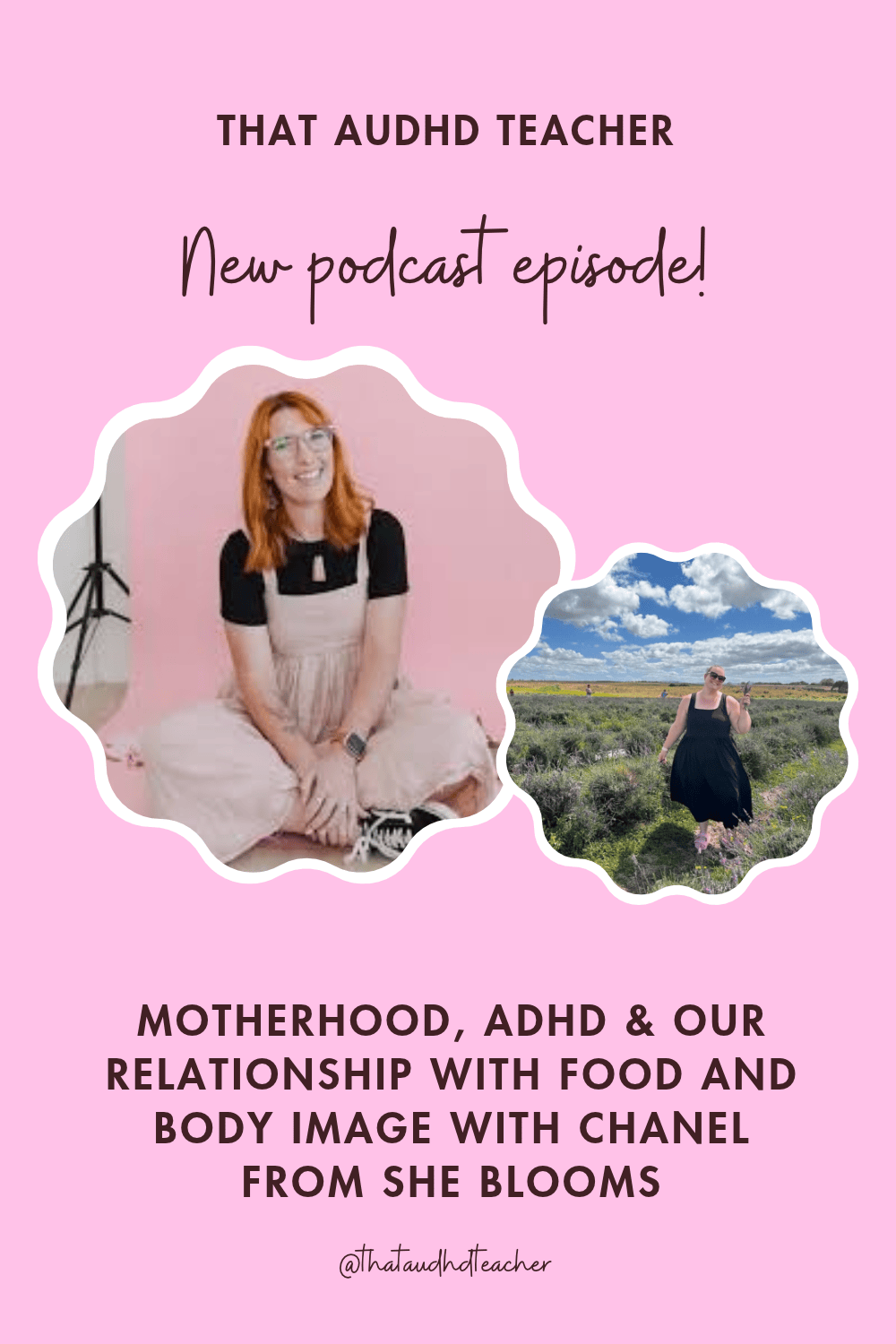
Motherhood is often talked about as something we instinctively know how to do. We grow up with ideas about the kind of parent we will be, how our family will look and what those early years might feel like. But what happens when the reality is very different from the expectations we have carried?
In a recent episode of That AuDHD Teacher, I spoke with Chanel, founder of She Blooms, about the intersections between motherhood, neurodiversity, perinatal mental health, and our relationships with food and body image.
Chanel’s story is a reminder that these experiences do not always sit in separate boxes. They can overlap, influence one another and shape how we understand ourselves.
When motherhood changes your sense of identity
Chanel always knew she wanted to become a mother. She had imagined that part of her life for years, but when she eventually had her first child, she found the experience much more confronting than she had expected.
She described the gap between the mother she had imagined becoming and the reality of motherhood. The expectations she had built up about what she would do, how she would parent and what life would look like did not necessarily match what happened. It was an enormous identity shift.
This is an important part of the conversation around parenthood that can sometimes get overlooked. Becoming a parent can bring joy and connection, but it can also involve grief for the life, identity or expectations that have changed. We can love our children deeply while still finding the transition difficult. For some people, the perinatal period can also bring existing challenges into sharper focus.
The relationship between food, coping and mental health
Chanel spoke openly about how food became a coping mechanism during a period of anxiety and significant change. Food was consistent. It was there when she needed comfort, and it provided temporary relief. At the time, she did not necessarily recognise the role it was playing in helping her manage difficult emotions.
After having her second child, Chanel made the decision to have gastric bypass surgery. She described this as a significant catalyst for change, not simply in terms of her physical health, but because it meant she had to look more closely at the patterns and coping strategies she had relied on.
Her story prompted a wider conversation about how our relationships with food and our bodies can be connected to our emotional experiences, mental health and neurodivergence. It is worth moving away from simplistic assumptions about food choices or eating behaviours. People’s experiences are shaped by many factors, and understanding the context matters.
Discovering ADHD and understanding yourself differently
Chanel’s ADHD diagnosis came after she moved into running her own private practice. While she loved the creativity and flexibility of working for herself, she also discovered that the loss of external structure and predictable routines made some aspects of daily work much harder. She described enjoying the creative parts of her business, but finding administration, planning, invoicing and organising much more difficult.
This experience led her to become curious about why things felt so challenging. That curiosity eventually led to her ADHD assessment and diagnosis. It is an interesting reminder that sometimes the things we have managed for years become more noticeable when our environment changes. We may have been relying on structures, routines or support systems without realising just how important they were.
Chanel also shared that she scored highly on autism screening measures during her assessment, but was not formally diagnosed autistic. She describes herself as ADHD and self-identifies with autistic traits.
Why neurodiversity, perinatal mental health, food and body image can overlap
One of the most interesting parts of our conversation was Chanel’s observation that these areas often intersect in her work. She described perinatal mental health, relationships with food and body image, and neurodiversity as three connected sides of a triangle. Not every person will experience all three, of course. But for many women, these experiences are not separate.
A person may reach parenthood and find that the demands of caring for a child make existing difficulties more visible. Sensory demands, disrupted sleep, changes in routine, emotional demands and the pressure to meet expectations can all become part of the picture. For some people, parenthood may be the point at which they begin questioning whether they are neurodivergent themselves.
Chanel has seen this happen when parents seek support or assessment for their children and begin recognising similar experiences in themselves.
Masking and why neurodivergence can be missed
We also talked about the way neurodivergent women and girls can mask their experiences. Chanel explained that children who do not feel safe to be themselves around the adults in their environment may mask more heavily. If a child is constantly trying to avoid getting into trouble or meeting expectations, the adults around them may not see the difficulties they are experiencing.
This can make recognising neurodivergence more complicated.
A child who appears to be coping in one environment may be working incredibly hard to do so. The absence of obvious behaviours does not necessarily mean that a child is not experiencing challenges.
We discussed how important it is for parents and educators to move beyond stereotypes about what autism or ADHD is supposed to look like.
There is no single way to look autistic or ADHD. And when we rely on narrow ideas of what neurodivergence looks like, we risk overlooking people who do not fit those expectations.
Understanding ourselves can change how we support our children
One of the most hopeful parts of the conversation was Chanel’s reflection on how understanding her own neurodivergence has influenced the way she parents. When parents begin recognising their own experiences, they may also start noticing similarities in their children. That awareness can change how they interpret behaviour.
Instead of automatically seeing a child’s differences as disobedience, bad behaviour or a need for more discipline, parents may begin asking what the child is communicating and what support or accommodation might help.
This does not mean every child is neurodivergent, or that every behaviour has the same explanation. It means being curious before making assumptions. For educators, this is an important reminder too. The way we interpret a child’s behaviour can influence how we respond to them and whether they feel safe to be themselves.
What is the difference between counselling and coaching?
Chanel also explained the difference between the counselling and coaching she offers through She Blooms. She described counselling as more like traditional talk therapy, where people can explore experiences, patterns and different aspects of their lives.
Coaching, on the other hand, is generally more practical and future-focused. It can involve taking what someone has learned about themselves and considering how they can use that understanding to support themselves moving forward.
Chanel also highlighted that coaching is not regulated in the same way as counselling, and that it is important for people to understand the qualifications, professional memberships and experience of anyone offering these services.
Making pregnancy, birth and postnatal support more neurodiversity informed
Towards the end of our conversation, Chanel shared some of her plans for future work in this area. She is interested in bringing neurodiversity more directly into conversations about pregnancy, birth and the postnatal period. This includes thinking about sensory profiles, noise, hormonal changes, overwhelm and the kinds of support a neurodivergent person might need at different stages. It is an area that deserves more attention.
Support during pregnancy and after birth is often discussed in general terms, but people do not all experience these transitions in the same way. Making space for neurodivergent experiences and different support needs could make a meaningful difference.
Listen to the conversation
I really enjoyed this conversation with Chanel. It brought together so many topics that are often discussed separately and highlighted how much there is still to understand about the connections between neurodiversity, motherhood, mental health, food and body image.
You can listen to the full conversation on That AuDHD Teacher.
To find out more about Chanel and her work, visit She Blooms: https://sheblooms.co.nz/about
This article reflects a conversation about personal experiences and professional practice. It is not intended as medical advice or a substitute for individual support.


Leave a Reply