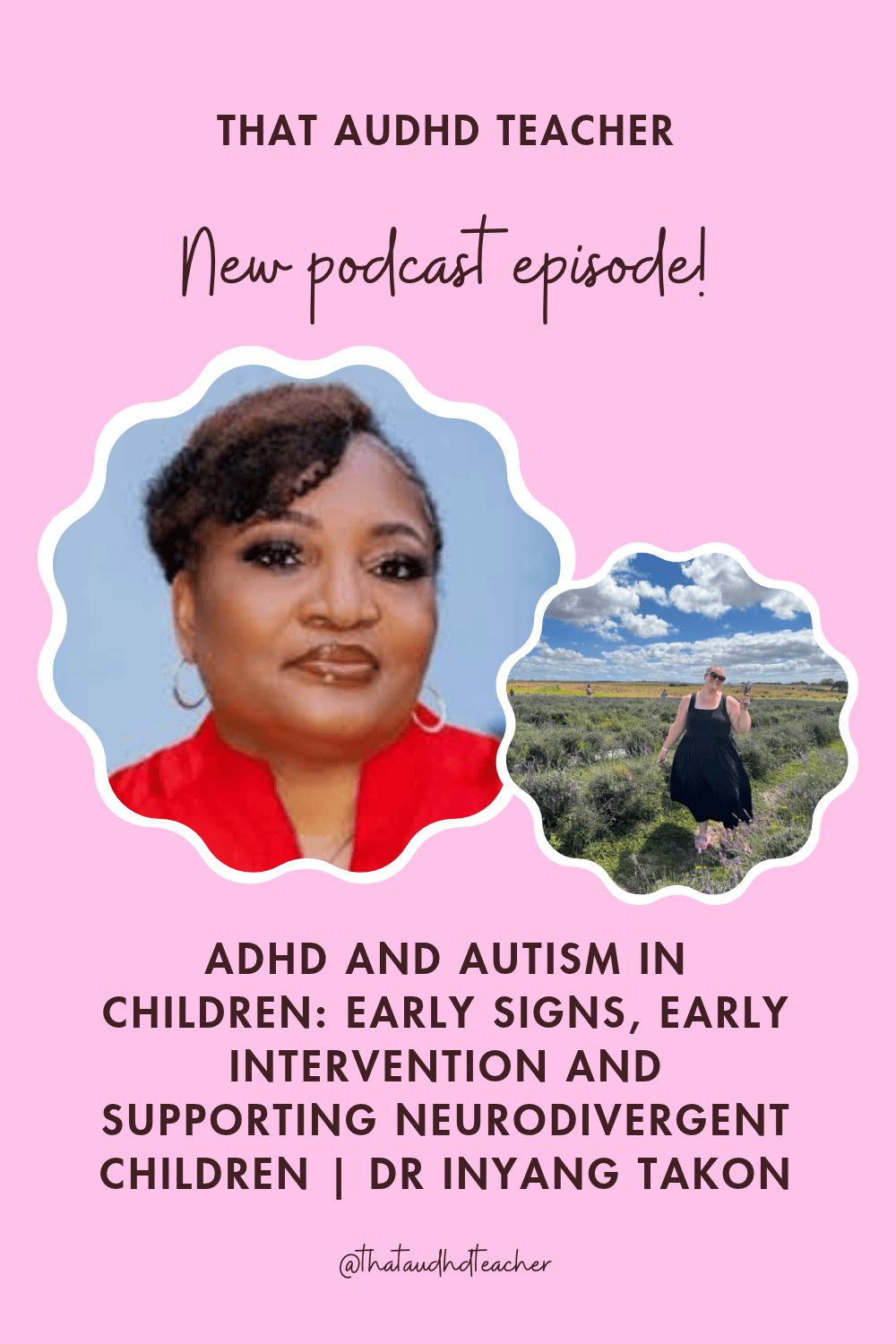
What happens when a child’s behaviour is misunderstood, their struggles go unrecognised, or the support they need is delayed until they receive a formal diagnosis? In a conversation with consultant paediatrician Dr Inyang Takon, we explore early identification, common misconceptions about ADHD and autism, and why supporting neurodivergent children should never have to wait for a diagnosis.
When we talk about ADHD and autism in children, it’s easy to focus on diagnosis. We talk about assessments, referral pathways, waiting lists and the process of getting answers.
But what about everything that happens in between? What happens to the child who is struggling in the classroom but hasn’t been identified? The child whose behaviour is repeatedly described as naughty, disruptive or oppositional? The child who is trying incredibly hard to meet expectations but doesn’t have the support they need?
These are some of the questions I explored in my recent conversation with Dr Inyang Takon, a consultant paediatrician specialising in neurodevelopmental and neurobehavioural disorders. With extensive experience assessing and supporting children with ADHD, autism, epilepsy, tic disorders and other developmental differences, Dr Takon brought a wealth of knowledge to our discussion.
One message stood out throughout the conversation: we don’t need to wait for a diagnosis before we start supporting a child.
Understanding ADHD and autism beyond common misconceptions
One of the things Dr Takon discussed was how our understanding of neurodevelopmental conditions has changed over time. Historically, the children who were recognised and diagnosed were often those who presented in more obvious or stereotypical ways.
For example, ADHD was frequently associated with a child who was constantly moving, running around, interrupting or struggling to sit still. However, ADHD doesn’t always look like this. Similarly, children with autism who didn’t fit the expectations of what professionals or families understood autism to look like could go unrecognised.
Dr Takon explained that some children were previously described as oppositional or defiant when, with a better understanding of their behaviour, their experiences were more consistent with autism or other neurodevelopmental differences.
She also highlighted several common misconceptions:
- If a child can concentrate on a computer game for hours, they can’t have ADHD.
- If a child is academically capable, they can’t be neurodivergent.
- If a child can do something they enjoy, they should be able to do everything else.
- Difficulties with behaviour are simply a result of poor parenting or a child being naughty.
These assumptions overlook the complexity of neurodivergence. A child can be bright, capable and successful in certain areas while experiencing significant difficulties elsewhere.
As Dr Takon explained, it’s important to look beyond whether a behaviour is present and understand its quality, context and impact on the child’s everyday life.
What should teachers and educators look out for?
As an early childhood teacher myself, this was one of the areas I was particularly interested in exploring. Educators spend considerable time observing children in social environments. We see how they interact with others, approach activities, manage transitions, respond to expectations and participate in everyday routines. This gives us valuable opportunities to notice patterns that might otherwise go unrecognised.
Dr Takon explained that teachers can sometimes identify differences by observing how a child participates compared with their peers.
For example, a child might:
- Frequently interrupt or call out.
- Constantly ask questions or become distracted by other things.
- Find it difficult to begin an activity even when others have started.
- Regularly seek opportunities to leave the classroom.
- Struggle to organise themselves or follow instructions.
- Find certain everyday expectations particularly challenging.
However, it’s important not to treat individual behaviours as proof of ADHD or autism. What matters is looking for persistent patterns, considering the child’s individual development and understanding how these difficulties affect their everyday functioning.
Dr Takon also recommended introducing strategies and monitoring how the child responds. This might include adjusting seating arrangements, offering movement breaks or making changes to the learning environment.
Educators can then observe whether these adjustments help and continue communicating with families about what they are noticing. This isn’t about teachers diagnosing children. It’s about recognising when a child might need additional understanding, support or assessment.
Working with parents when there are concerns
Another important part of our conversation was how educators approach discussions with parents. Raising concerns about a child’s development can be difficult. Parents may feel defensive, worried or even upset when someone suggests their child might be neurodivergent.
Dr Takon explained that some parents have fears about what a diagnosis might mean for their child. They may worry about stigma, how others will treat their child or whether their child will be disadvantaged in the future. Sometimes, these concerns are connected to cultural beliefs or previous experiences.
Her advice was to approach these conversations collaboratively rather than confrontationally. Instead of telling parents what you think their child has, focus on the specific behaviours and patterns you have observed. Explain what you are doing to support the child within the educational environment, discuss strategies that might also be helpful at home, and continue monitoring their development. Regular communication and sharing useful resources can help families become more comfortable exploring their concerns.
Importantly, parents don’t necessarily have to agree with the possibility of a diagnosis before educators can begin introducing supportive strategies.
Cultural differences and the understanding of neurodiversity
I was particularly interested in hearing Dr Takon’s perspective on cultural differences. Having lived and worked in Africa before moving to the UK, she discussed how cultural beliefs and expectations can influence how neurodivergence is understood.
In some communities, behaviours associated with ADHD or autism may be interpreted as poor parenting, a lack of discipline, laziness or a child simply behaving badly. These beliefs can make it much harder for families to recognise developmental differences or seek appropriate support.
She also highlighted that moving to another country doesn’t necessarily mean someone leaves those cultural beliefs behind. This is particularly relevant in multicultural communities such as New Zealand and the UK.
As educators and professionals, we need to recognise that families bring different experiences, expectations and understandings of child development. Building relationships, communicating patiently and finding accessible ways to explain developmental differences can make a significant difference.
Why early identification and intervention matter
One of the most important parts of our discussion was the impact of delayed identification. Dr Takon explained that the early years are a particularly important period for development and learning.
When a child’s needs aren’t recognised, they may spend years experiencing difficulties without understanding why. As expectations increase, these difficulties can become more noticeable.
A child who has repeatedly been told off, struggles to keep up with peers or feels that they are always getting things wrong may begin to develop low self-esteem. Over time, this can contribute to anxiety, difficulties with friendships, school refusal and other emotional and mental health challenges.
Early identification creates opportunities to provide appropriate support before these difficulties become more significant. But there’s an important distinction here. Early intervention doesn’t necessarily mean receiving an immediate diagnosis. It means recognising what a child is finding difficult and responding with appropriate strategies and support.
You don’t need to wait for a diagnosis to provide support
This was probably my favourite part of the conversation. Dr Takon spoke about an approach she calls ‘Waiting Well’. The idea is that children who are waiting for an assessment shouldn’t be left without support.
In some cases, families may wait years for an appointment. During that time, the child’s needs don’t disappear. Dr Takon explained that educators and families can begin introducing appropriate strategies while the child is still waiting for assessment.
This might involve:
- Making adjustments to the learning environment.
- Providing additional opportunities for movement.
- Offering clearer instructions and support with tasks.
- Recognising individual sensory and communication needs.
- Providing predictable routines and additional preparation for transitions.
- Supporting families with information and practical strategies.
The important thing is to focus on what the child needs rather than waiting for someone to confirm a diagnostic label. A diagnosis can provide valuable understanding, but it shouldn’t be the starting point for compassion, accommodations or support.
ADHD medication: Understanding the role it can play
We also discussed ADHD medication and some of the concerns families may have about it. Dr Takon explained that medication has a place in ADHD management, but it isn’t necessarily the first step following diagnosis in her clinical approach.
She described the importance of psychoeducation, helping parents understand ADHD and working with schools to introduce appropriate strategies. She discussed how medication may be considered when a child continues to experience significant difficulties despite these supports.
We also explored why medication can feel like a particularly big decision for parents and why open, supportive conversations are important. This part of our discussion highlighted that ADHD support isn’t one size fits all. Families need information, opportunities to ask questions and support in understanding the different approaches available.
What can parents do if they’re concerned about their child’s development?
Towards the end of our conversation, I asked Dr Takon what she would recommend to parents who are concerned about their child’s development. Her advice was practical and something I think many families could benefit from.
1. Document what you’re noticing.
Rather than relying on memory, write down the specific behaviours or developmental differences you have noticed.
Include when they happen, how frequently they occur and whether they are also noticed in other environments.
2. Gather information from other people involved in your child’s life.
If educators or other professionals have noticed similar things, ask them to document their observations.
Information from different environments can help build a clearer picture of the child’s development.
3. Seek appropriate professional advice.
Take your observations and any relevant information to your GP, paediatrician or another appropriate health professional.
Dr Takon also highlighted the value of video recordings when it’s difficult to explain or describe a particular behaviour.
Having this information prepared can make assessment appointments more productive and help parents communicate their concerns.
Moving beyond diagnosis
Throughout this conversation, I kept coming back to one important idea: supporting neurodivergent children needs to be about more than identifying a diagnosis. We need to consider the child’s everyday experiences, the environments they are navigating and the people responsible for supporting them. As an early childhood educator and someone who was diagnosed with AuDHD as an adult, I find these conversations particularly important.
I know how valuable understanding can be, and I also think about the children who are growing up without the information or support that could make their experiences easier. We need more awareness, more professional development for educators and better communication between families, schools and health professionals. Most importantly, we need to recognise that children deserve support because they need it, not because they have managed to obtain a diagnosis.
Listen to the full conversation
I really enjoyed speaking with Dr Inyang Takon and hearing about her work supporting children, families and professionals.
You can listen to the full episode of That AuDHD Teacher on Spotify and watch the conversation on YouTube.
Connect with Dr Inyang Takon
Dr Takon has developed several platforms and resources to support parents, educators and health professionals.
- Website: https://www.drtakon.com/
- School Doctor: https://school-doctor.com/
- School Doctor resources: https://school-doctor.com/resources/
- Early Intervention Matters podcast: Available through her website.
- Brain Diverse: https://braindiverse.org/
- Instagram: https://www.instagram.com/early_interventionmatters/
- LinkedIn: https://www.linkedin.com/in/inyang-takon-paeds/
- Substack: https://neuropaeddoc.substack.com/
- Email: eim@drtakon.com
I particularly encourage parents and educators to explore the resources available through School Doctor and Brain Diverse.
This article and podcast conversation are for educational and informational purposes. They are not a substitute for individual medical advice, assessment or diagnosis. If you have concerns about a child’s development, seek advice from an appropriate health professional.



Leave a Reply