Music is something many of us enjoy, whether that’s listening to our favourite songs, singing along in the car, dancing around the kitchen or playing an instrument. But music can also be much more than entertainment. For some people, it can be a meaningful way to communicate, connect, learn and develop skills.
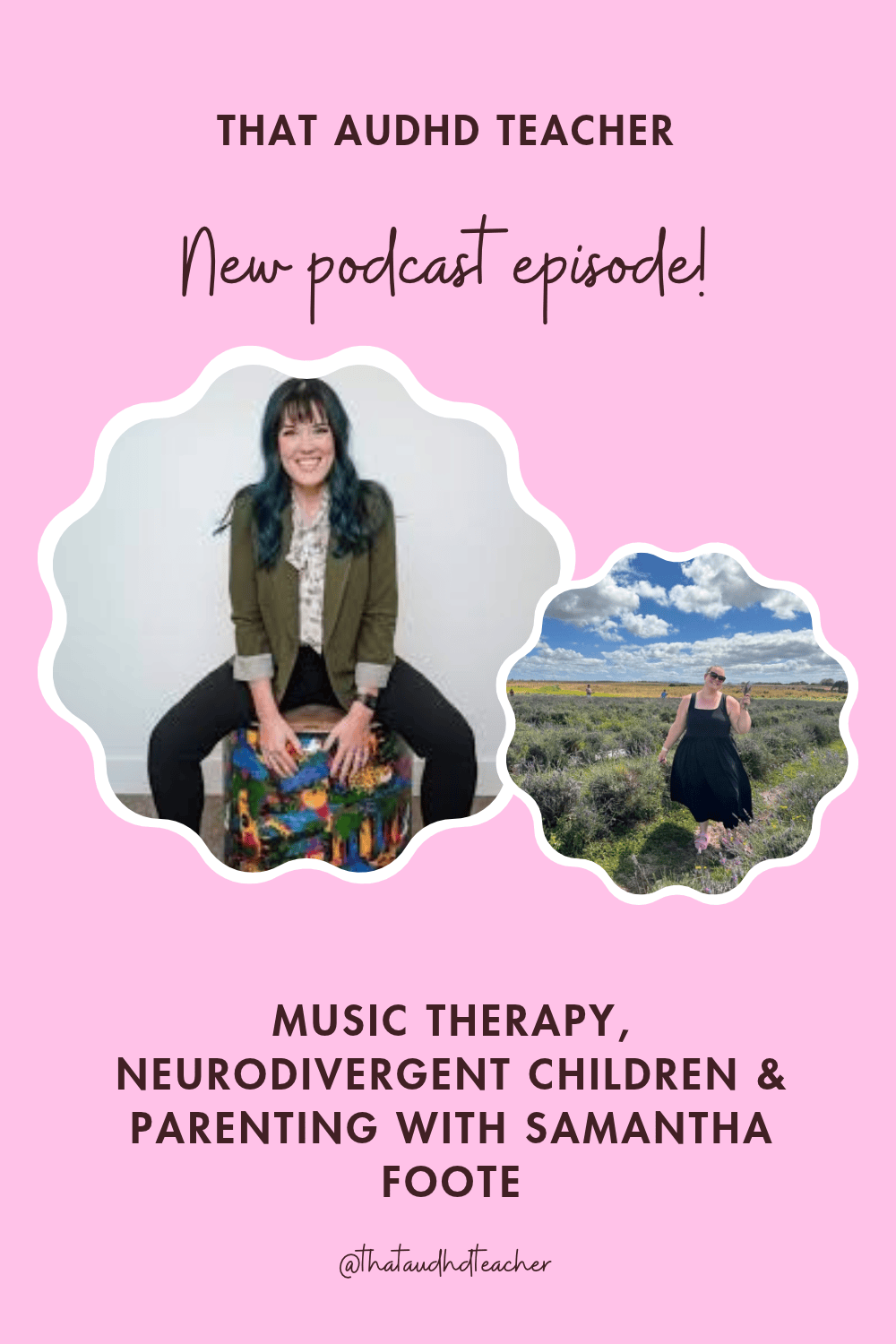
In this episode of That AuDHD Teacher, I spoke with Samantha Foote, a music therapist who has spent around 15 years working with children and adults with autism and other developmental disabilities. Samantha is also a parent of three neurodivergent children and co-host of Every Brain Is Different.
Our conversation covered music therapy, parenting, sensory needs, diagnosis, self-advocacy and the importance of recognising that every brain is different.
What is music therapy?
Before this conversation, I didn’t know very much about music therapy. I knew it existed, but I hadn’t realised how many different ways it could be used.
Samantha explained that music therapy involves working towards non-musical goals using music. These might include communication, speech production, motor skills, cognitive development, social skills or emotional goals.
Music can provide another way to access and practise skills. Samantha shared examples from her work, including supporting a child with movement following brain surgery and working alongside a speech therapist to help a child understand spoken questions.
In the latter example, Samantha sang questions that the speech therapist provided. The child was able to respond to the sung questions, and over time they gradually reduced the use of music as the child developed the ability to understand spoken questions.
I found this particularly fascinating because it showed how music can provide an alternative pathway when more conventional approaches aren’t working in the same way.
Samantha also explained that you don’t need to be musical to benefit from music therapy. You don’t need to play an instrument or have any musical experience. Music therapists bring the instruments and help people participate in ways that work for them.
Music doesn’t have to be complicated
One of my favourite parts of the conversation was hearing how Samantha uses music in everyday family life. She doesn’t necessarily mean formal music lessons or structured activities. Sometimes it’s as simple as turning on a song and having a dance party.
Samantha shared some practical examples:
- Use a song to make a task feel manageable. Rather than asking a child to clean their entire bedroom, try putting on one song and agreeing to tidy for the duration of that song. The task becomes smaller and more achievable.
- Make up silly songs together. Singing instructions or turning everyday routines into songs can make interactions more playful.
- Have a dance party. Moving and making music together can create opportunities for connection and shared enjoyment.
- Explore instruments together. You don’t need to know what you’re doing. Samantha suggested experimenting with the piano, including playing only the white keys or only the black keys.
- Use music to change the atmosphere. Sometimes a song or a shared movement activity can help interrupt a tense moment and create an opportunity to reconnect.
These ideas stood out to me because they don’t require expensive equipment, specialist musical knowledge or a perfectly planned activity. They can be part of ordinary family life.
Supporting children before overwhelm escalates
We also discussed how music and movement can be useful in early childhood and school environments.
Samantha suggested that educators can use music breaks before a child reaches a point of significant distress. If we notice a child becoming unsettled or showing signs of escalation, a planned movement activity might offer an opportunity to shift gears.
She mentioned using movement songs, egg shakers and scarves. These give children something to focus on while also creating opportunities to move their bodies.
One idea she described was using songs that invite children to move different parts of their bodies, sometimes in unexpected ways. Even something as simple as wiggling your eyebrows can bring a different kind of focus to an activity.
Of course, no strategy works for every child or every situation. Sometimes distress escalates very quickly, and sometimes a child needs a quieter environment rather than another activity. The important thing is knowing the children, noticing their cues and having different options available.
It was a useful reminder that supporting children doesn’t always mean waiting until something has gone wrong and then trying to manage the behaviour. We can also think about what might help earlier.
Sensory needs, self-advocacy and listening to children
Samantha shared her experience of parenting her eldest son, who has significant sensory differences.
As a young child, he found many sensory experiences difficult. Even touching frosting on his first birthday cake was overwhelming. Samantha described how occupational therapy helped him gradually become more comfortable with some of the experiences he had previously avoided.
One of the things that stayed with me was hearing how he has developed the ability to recognise when an environment is becoming too much and ask for a break.
Samantha shared an example of being at a family gathering where things were loud. Her son asked whether he could go outside. At first, she interpreted this as wanting to go outside, but then realised he was communicating that he needed to get away from the noise and the group. They were able to work out a safe way for him to have that space.
This is such an important distinction. Sometimes children don’t have the words to explain exactly what is happening for them. Their requests and behaviours may be communicating a need that isn’t immediately obvious to the adults around them.
Samantha also talked about how her son has become more confident in recognising when he needs to leave an overwhelming situation. Rather than reaching a point where he has a meltdown, he is increasingly able to notice that feeling building and ask for a break.
I think this is something we should want for all children: not simply learning to tolerate uncomfortable situations, but developing the confidence and understanding to recognise and communicate what they need.
Why diagnosis and understanding matter
Samantha also shared her own experience of being diagnosed with ADHD and OCD. She described having a busy internal world from a young age, alongside experiences and patterns she didn’t realise were related to OCD. For much of her life, she assumed these experiences were normal because they were what she knew. She eventually received an ADHD diagnosis as an adult, after years of wondering whether it might explain some of her experiences.
She described how life changing it was to have an explanation for things she had struggled with, including her emotions, social relationships and the constant activity in her mind.
We talked about why diagnosis can be important beyond medication or access to services. For many people, understanding their neurotype can help them make sense of experiences that they may previously have interpreted as personal failures or flaws.
Samantha reflected on how she spent much of her life trying to be what she thought was ‘normal’, and how much shame can come from believing that everyone else can manage things that feel difficult for you.
This is something I relate to as a late-diagnosed AuDHDer. There can be a lot to untangle when you finally have language for experiences you’ve carried for years.
A diagnosis doesn’t define a person, but it can offer an explanation. It can also give children and adults the opportunity to understand themselves and develop strategies that work with their brains rather than constantly trying to work against them.
Neurodivergent parents need support too
We often talk about supporting neurodivergent children, but Samantha raised another important point: what about the parents?
Samantha has ADHD and is parenting three children who have autism and ADHD. She explained that parenting can become particularly challenging when a parent’s sensory needs and those of their child are very different.
She created Every Brain Is Different to provide resources, education and support for families navigating neurodivergence. This includes parent consultations and conversations about positive parenting approaches, understanding diagnoses and looking after yourself as a parent.
I think this is an important area that deserves more attention. Supporting a neurodivergent child is not just about understanding the child in isolation. We also need to consider the adults caring for them and the demands they are navigating. Parents need support, understanding and practical strategies too.
We need neurodivergent educators
Another part of our conversation that really resonated with me was the value of neurodivergent teachers and professionals.
As an early childhood teacher and late-diagnosed AuDHDer, I’ve become increasingly aware of how many educators discover their neurodivergence after entering the profession. Some find that the realities of working in busy environments, managing sensory demands and meeting competing expectations can be incredibly challenging.
Samantha agreed that neurodivergent educators can bring a level of understanding that may be missing when a child’s needs are viewed only through a neurotypical lens.
A teacher who remembers what it felt like to struggle with noise, needing movement or finding certain classroom expectations difficult may recognise something that another adult overlooks.
That doesn’t mean neurodivergent educators should be expected to do all the work of supporting neurodivergent children. They need understanding and support themselves. But their lived experience can be valuable, and we should be thinking about how to retain and support them in education.
We are all learning
Towards the end of our conversation, Samantha shared a reminder that I think applies to parents, educators and therapists alike. She talked about looking back at things she had been taught to do in her professional training, including working towards eye contact goals for children. With the knowledge she has now, she wouldn’t choose those goals.
But she also recognised that she was working with the information and guidance available to her at the time. We cannot change what we didn’t know in the past. What we can do is keep learning, reflect on our practices and make different choices as our understanding develops.
Samantha also had a message for parents who find themselves looking back and feeling guilty about things they did before they understood their child’s needs: When you know more, you do better.
I think that’s a message worth remembering. We don’t need to spend all our energy blaming ourselves for what we didn’t know yesterday. We can take what we’ve learned and use it to support children differently today.
Listen to the conversation
I really enjoyed this conversation with Samantha. I learned a lot about music therapy, but I also appreciated the wider discussion about parenting, diagnosis, sensory needs and helping children develop the confidence to advocate for themselves.
We don’t all communicate, learn or experience the world in the same way. The more willing we are to explore different approaches, listen to children and keep learning, the more opportunities we create for them to thrive.
Find Samantha:
- Every Brain Is Different: https://podcasts.apple.com/nz/podcast/autistic-and-adhd-kids-parenting-strategies-every/id1697406719
- Music therapy: Boise Music Therapy
- Social media: @boisemusictherapy


Leave a Reply