ADHD accommodations are something I have thought about a lot since my own diagnosis. Before I understood my brain, I spent a lot of time assuming that if something was difficult for me, the answer was to try harder.
Be more organised. Make another list. Set another reminder. Stop procrastinating. Just start. Pay more attention. Be more disciplined. And sometimes those things worked. But sometimes they really, really didn’t.
One of the things that has changed for me since learning more about ADHD is realising that knowing what I should do and being able to actually make myself do it are not always the same thing. And that distinction matters.
What is an ADHD accommodation?
An accommodation is essentially a change that helps make something more accessible without changing the underlying expectation or goal.
It isn’t about getting an unfair advantage. It isn’t about being given an easier life. And it certainly isn’t about lowering someone’s expectations because they have ADHD.
Sometimes it is simply about removing an unnecessary barrier. For someone with ADHD, that barrier might be remembering information, starting a task, understanding vague instructions, managing time, switching between activities, filtering distractions, regulating emotions or dealing with an overwhelming environment.
A small change can sometimes make a surprisingly big difference. And I think this is something we need to talk about much more.
My own experience
I was diagnosed with ADHD as an adult, and looking back, there are so many things that make more sense now. Not because suddenly everything in my life can be explained by ADHD. It can’t. But because I have a better understanding of why some things have always seemed to require so much more effort than they appeared to require for other people.
I’ve always known that I could be organised. I could be successful. I could get things done. So when I struggled, it was very easy to assume that I simply wasn’t trying hard enough. And I think this is one of the complicated things about ADHD.
You can be incredibly capable and still struggle with things that seem like they should be easy. You can meet deadlines and still have spent the entire day fighting your brain to get there. You can be described as organised while having approximately seventeen systems for trying to stay organised because the previous sixteen stopped working. You can know exactly what needs to happen next and still be completely unable to start. You can care enormously about something and still procrastinate until the pressure becomes unbearable.
For a long time, I thought these contradictions meant there was something wrong with me. Now I understand them differently.
I didn’t necessarily need to try harder. I sometimes needed things to work differently.
That has been a really important shift for me.
Instead of asking, “Why can’t I just do this?”, I’m learning to ask: “What would make this easier for my brain?”
Sometimes the answer is a practical accommodation.
Maybe I need something written down rather than relying on remembering a verbal conversation. Maybe I need a visual reminder. Maybe I need to break something into much smaller steps. Maybe I need a timer. Maybe I need somebody else around while I get started. Maybe I need fewer distractions. Maybe I need more time to process something before I’m expected to respond.
None of those things change what I am capable of. They change the amount of unnecessary executive functioning required to get there.
Accommodations aren’t one size fits all
One thing I really want to emphasise is that there isn’t a magical list of ADHD accommodations that will work for every person with ADHD.
ADHD is incredibly varied. Something that helps one person might be completely useless to another. Some people need more structure. Other people feel trapped by too much structure. Some people need reminders. Other people become so overwhelmed by notifications that they ignore them all. Some people work best with background noise. Others need complete silence. Some people need movement. Others need a quiet, low stimulation environment.
The point isn’t to find the ADHD solution. It’s to work out what your barriers are and what might help reduce them.
Accommodations can be really small
I think sometimes we imagine accommodations as being big, formal things. But they don’t always have to be.
An accommodation might be:
- having instructions written down
- breaking a large task into smaller steps
- using a visual checklist
- setting an alarm before a transition
- using a timer to make time more visible
- having a quieter place to work
- using headphones
- having extra processing time
- using body doubling
- receiving reminders about important deadlines
- having clear and explicit expectations rather than vague instructions
- being able to take a short movement break
- having information in more than one format
Sometimes the smallest change removes the biggest barrier.
What about the idea that accommodations are “special treatment”?
This is something I wish more people understood.
If someone needs glasses to see the board, we don’t say that glasses give them an unfair advantage. If someone needs a ramp to access a building, we don’t say that the ramp gives them an easier route.
The accommodation isn’t creating the difficulty. It’s helping remove a barrier that was already there.
ADHD accommodations work in a similar way. They aren’t about giving someone an advantage over everyone else. They’re about making it possible for someone to access the same opportunity in a way that works for their brain. And sometimes the accommodation isn’t even something another person would notice.
You don’t have to earn support by struggling enough
This is probably one of the biggest things I want people to take away from this.
You can be successful and still need accommodations. You can have a job. You can have qualifications. You can be reliable. You can look organised from the outside. You can be very good at what you do. And you can still be exhausted by the amount of effort it takes to maintain all of that.
For me, understanding ADHD accommodations has been partly about recognising the difference between being able to do something and being able to do it sustainably. Those aren’t necessarily the same thing.
What would make things easier for you?
I think this is a much more useful question than: “Why can’t I just do it?”
If something is consistently difficult, try getting curious about the barrier.
Is it starting? Remembering? Time? Sensory input? Transitions? Communication? Too many steps? Not enough structure? Too much structure? Emotional overwhelm? Something else entirely?
And then ask: What could I change?
Not “How can I force myself to be better at this?”
But: “What could make this more accessible?”
That doesn’t mean giving yourself permission to avoid everything that is difficult. It means recognising that sometimes the most effective solution isn’t more effort. Sometimes it’s a different approach.
I’ve created a free ADHD Accommodations Guide
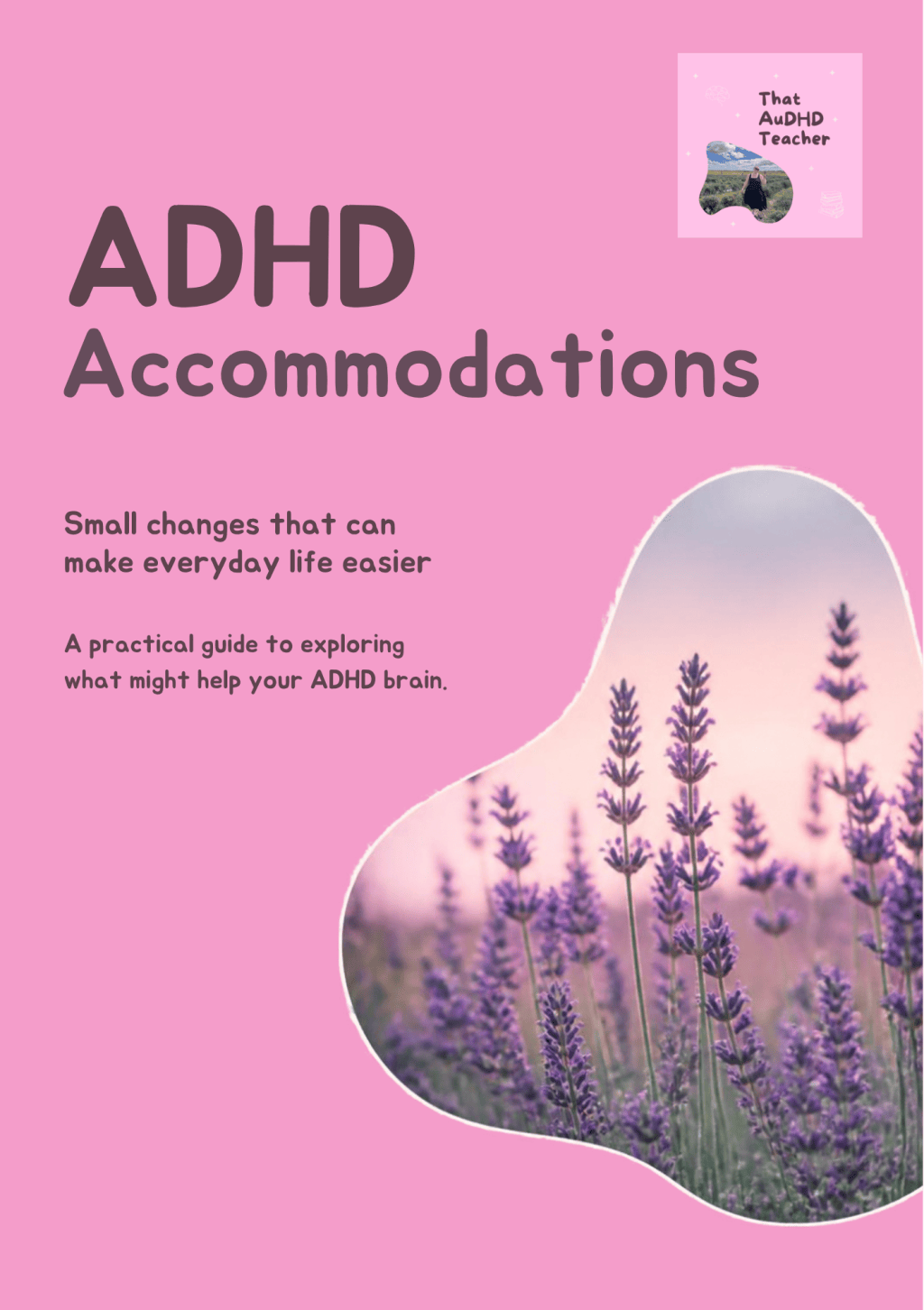
I’ve put together a free ADHD Accommodations Guide to go alongside this post.
It includes practical accommodation ideas around planning, organisation, task initiation, time, sensory needs, communication and emotional regulation.
I’ve also included space to think about your own needs, because ultimately the most useful accommodation is the one that actually helps you.
You can download it here: ADHD Accomodations Guide
And if you’re someone who is still figuring out what your ADHD means for you, I hope this gives you permission to experiment. You don’t have to keep doing something the hardest possible way just because you’ve always done it that way.
You are allowed to find ways of doing things that work better for your brain.
Want to hear more?
If this is a topic you’d like to explore a little more, I also talk about ADHD, autism, late diagnosis and my experiences as an AuDHD teacher on The That AuDHD Teacher Podcast.
The podcast is a space where I talk honestly about the things I’ve learned since discovering I’m AuDHD, including the parts of neurodivergence that aren’t always obvious from the outside. I share my own experiences, conversations with guests and the things I wish I’d understood much earlier.
If you’d like to listen, you can find The That AuDHD Teacher Podcast on Spotify and YouTube.


Leave a comment