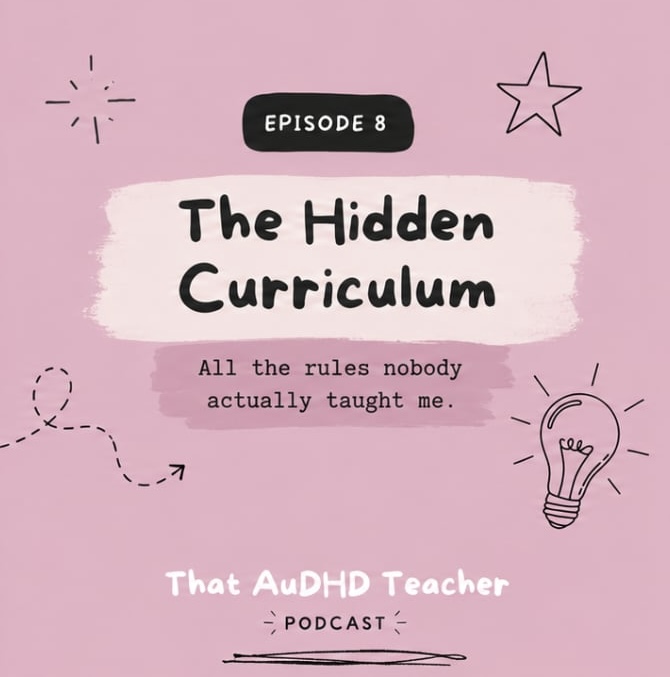
All the rules nobody actually taught me
There are so many rules in life that nobody ever seems to explain. You just somehow know them. Or at least, that’s what it can feel like.
You’re expected to know when to speak. How long to make eye contact. How much information is too much information. When it’s your turn to talk. How close to stand to someone. How to tell whether someone is interested in what you’re saying. When a conversation is finished. How you’re supposed to respond to certain situations.
Nobody necessarily sits you down and teaches you. You are simply expected to know.
This is part of what people sometimes refer to as the hidden curriculum.
What is the hidden curriculum?
The hidden curriculum refers to the unwritten social expectations, behaviours and norms that people are expected to understand without them necessarily being explicitly taught.
In education, we often think about the hidden curriculum in terms of things children learn beyond the formal curriculum.
But there is also a social hidden curriculum. And this is something I’ve thought about a lot since understanding my own autism.
What happens when you don’t automatically pick up the rules?
For some autistic people, social expectations aren’t always intuitive.
That doesn’t mean they don’t care about other people.
It doesn’t mean they don’t want friendships. It doesn’t mean they don’t understand emotions. It can simply mean that some of the unwritten rules aren’t automatically obvious.
So instead, you might have to learn them consciously. Watch. Observe. Copy. Remember. Analyse. Try again.
And eventually, some of those rules become automatic. Or at least they look automatic from the outside.
I became very good at observing
Looking back, I think observation played a huge role in how I navigated social situations.
I watched other people. How did they respond? What did they say? How long did they talk? When did they laugh? What did they do with their hands? How did they know when the conversation was finished?
It wasn’t necessarily something I consciously thought about every time.
But learning social behaviour through observation can be very different from simply intuitively knowing what to do. And that can be exhausting.
There are rules everywhere
The hidden curriculum isn’t just about social interaction. It can show up in workplaces too.
There are often expectations that aren’t written anywhere.
How quickly are you expected to respond to a message? When is it okay to ask for help? How much detail is appropriate? When should you speak in a meeting? What does “just pop in when you have a minute” actually mean? How are you supposed to know whether something is urgent?
What does someone mean when they say: We’ll see
We’ll see
These things can seem completely obvious to one person and incredibly ambiguous to another.
Teaching has its own hidden curriculum
Education is full of unwritten expectations. As teachers, we’re constantly navigating them.
What does being a “good teacher” look like? How enthusiastic should you be? How flexible should you be? How quickly should you respond? How much should you take on? How do you balance being professional with being yourself?
And there can be an enormous amount of pressure to intuitively understand those expectations.
For an AuDHD teacher, having to constantly decode these things can add another layer of cognitive load.
What if we made the rules more visible?
One thing I find interesting is that making expectations explicit can help everyone.
Instead of assuming someone knows what “ASAP” means, explain when you need something.
Instead of assuming people know how a meeting will work, explain the structure.
Instead of expecting someone to intuitively understand an unwritten workplace expectation, communicate it.
Instead of telling a child to “use your manners,” explain what that actually means in the situation.
Clarity isn’t a burden. Often, it’s supportive.
The hidden curriculum and children
This is particularly relevant to my work in early childhood education. Children are constantly learning social expectations. But they shouldn’t have to be able to intuitively decode everything around them.
We can make expectations explicit. We can model them. We can explain them. We can give children time. We can recognise that behaviour we interpret as “not following the rules” might sometimes reflect a child not understanding what the rule actually is.
That doesn’t mean there are no boundaries. It means we can teach rather than assume.
What I’ve learned about myself
Understanding the hidden curriculum has made me more compassionate towards the younger version of myself.
There were so many things I thought everyone else just knew.
And when I didn’t know them, I assumed there was something wrong with me.
Now I can look back and think: Maybe I wasn’t failing at understanding the rules. Maybe nobody had actually explained them. And perhaps that’s an important distinction.
🎧 Listen to Episode 8
This post accompanies Episode 8 of the That AuDHD Teacher podcast, where I explore the hidden curriculum, the unwritten rules we are often expected to understand, and how this has shaped my own experiences.




Leave a comment