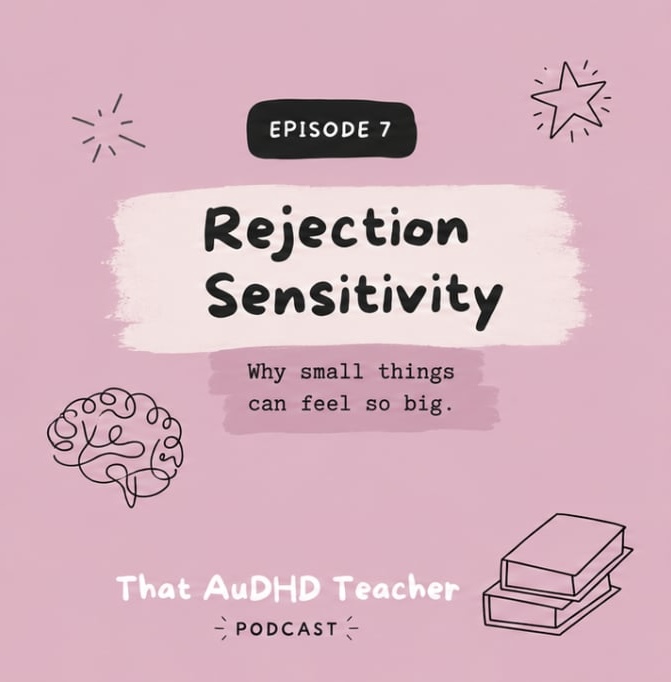
Why small things can sometimes feel incredibly big
Have you ever received a completely ordinary piece of feedback and immediately felt like you’d done something terribly wrong?
Someone takes slightly longer to reply to your message. Someone’s tone sounds different. A colleague gives you feedback. Someone doesn’t seem as enthusiastic as you expected.
And suddenly your brain starts filling in the gaps. They’re annoyed with me. I’ve done something wrong. They don’t like me. I’ve messed this up. I’ve disappointed them.
For me, learning about rejection sensitivity helped me understand some of these reactions differently.
What is rejection sensitivity?
Rejection sensitivity generally refers to being particularly sensitive to the possibility of rejection, criticism, disapproval or perceived failure.
It can involve anticipating rejection, interpreting ambiguous situations negatively, or experiencing a very strong emotional response when rejection is perceived.
You’ll often hear the term RSD: rejection sensitive dysphoria, in ADHD and neurodivergent communities.
It’s important to note that RSD isn’t a formal diagnosis in itself. But the experience of intense emotional responses to perceived rejection is something many people with ADHD describe. And it can be incredibly real.
The rejection doesn’t have to actually happen
This is something I find particularly interesting. Sometimes the other person hasn’t rejected you at all. They haven’t said anything negative. They might simply be busy. They might have a different tone because they’re tired. They might not have replied because they’re doing something else. But your brain has already started constructing a story.
And once that story is there, the emotional response can arrive very quickly. The logic can come later.
Knowing something isn’t true doesn’t always make the feeling disappear
This is perhaps the hardest part. You can know rationally that someone isn’t angry with you.
You can tell yourself: They’ve probably just had a busy day.
They’ve probably just had a busy day.”
And still feel awful.
The emotional response doesn’t necessarily disappear simply because you can logically explain the situation.
I’ve had to learn that knowing and feeling aren’t always operating on the same timeline.
Feedback can be complicated
As a teacher, feedback is unavoidable. Feedback is important. We need it. We learn from it. We grow through it.
But that doesn’t mean receiving it is always emotionally easy.
Sometimes a small piece of constructive feedback can trigger a much bigger emotional reaction than the situation itself seems to warrant.
And then there’s the second layer: Why am I reacting like this?
Which can create shame on top of the original emotion.
The spiral
For me, rejection sensitivity can sometimes look like a spiral.
Something happens. I notice it. I interpret it. I analyse it. I replay it. I look for evidence. I imagine what the other person might be thinking. I think about what I should have said.
Then I think about all the other times something similar happened.
And suddenly I’m dealing with a whole collection of emotions that started with something incredibly small.
This is where understanding the pattern has helped. Not because I can always stop it. But because I can sometimes recognise: Oh. I’m spiralling
Oh. I’m spiralling
It doesn’t mean you’re too sensitive
I think this is an important distinction. Feeling something intensely doesn’t mean you’re choosing to overreact. And telling someone to “just stop caring what people think” isn’t particularly helpful.
The goal isn’t necessarily to stop caring. It’s to understand what is happening and develop ways of responding that don’t leave you completely overwhelmed.
Sometimes that means giving yourself time before responding. Sometimes it means checking the facts. Sometimes it means talking it through with someone you trust. Sometimes it means reminding yourself that a feeling can be real without the story attached to that feeling necessarily being true.
The teacher side of rejection sensitivity
Teaching involves a lot of interpersonal relationships. Children. Whānau. Colleagues. Leaders. Other professionals.
There are endless opportunities for feedback, misunderstanding and uncertainty.
And when you’re already sensitive to perceived rejection, that can be exhausting.
You might replay a conversation from work hours later. You might worry that someone misunderstood what you meant. You might spend far too long thinking about an email. You might take constructive feedback as evidence that you’re failing.
Recognising that pattern doesn’t mean ignoring genuine feedback.
It means learning to separate: I received feedback
I received feedback.”
from: I am a failure
am a failure.”
Those are not the same thing.
Learning to pause
One of the most useful things I’ve been learning is to create a gap between the event and my response.
Something happens. I feel it. And instead of immediately deciding what it means, I try to pause.
What actually happened? What am I assuming? What evidence do I have? Could there be another explanation?
It’s not always easy. But that little pause can sometimes prevent an emotional reaction from becoming a full spiral.
🎧 Listen to Episode 7
This post accompanies Episode 7 of the That AuDHD Teacher podcast, where I talk more about rejection sensitivity, how I’ve experienced it and why seemingly small interactions can sometimes create very big emotional responses.




Leave a comment